The Paradox: Higher Rates, Lower Revenue
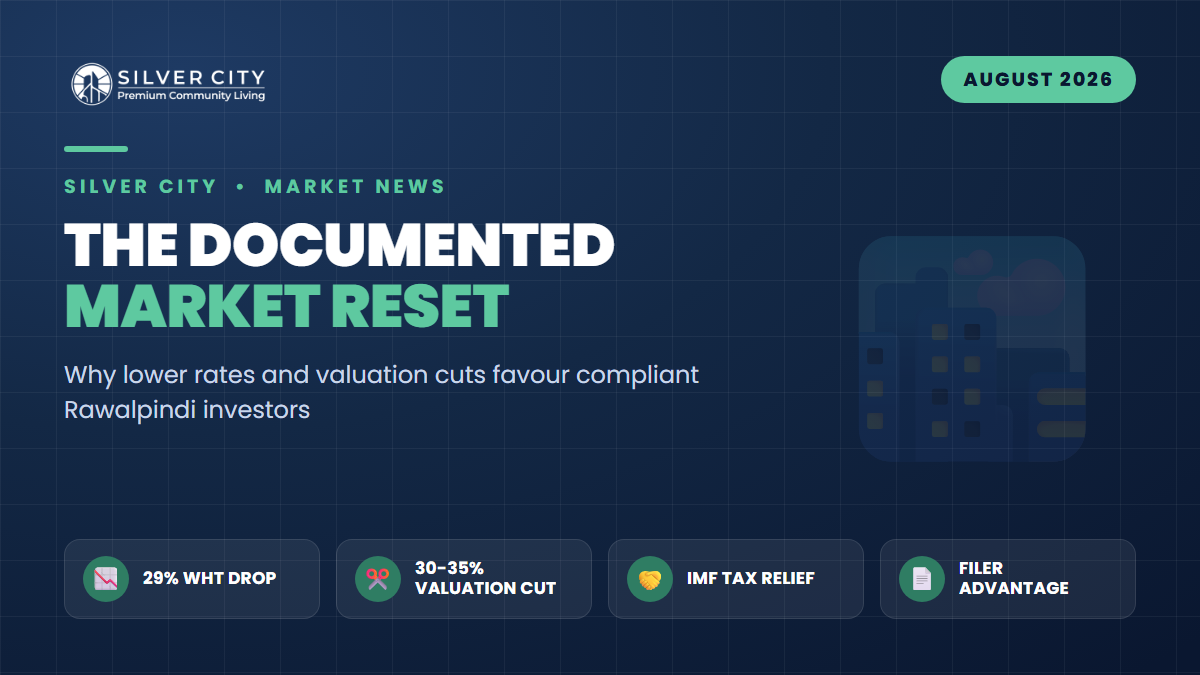
For three years, the conventional wisdom in Pakistan’s tax policy was simple — raise withholding tax (WHT) on property, and the treasury collects more. FY2025-26 broke that assumption in public. According to the FBR’s own numbers, withholding revenue from the real-estate sector fell by roughly 29% during the year, even as headline rates sat at record highs. The reason is uncomfortable but well understood by every property dealer in Rawalpindi: punitive rates did not stop transactions — they pushed them into undocumented channels, informal “power of attorney” arrangements, and delayed registrations.
The split inside the data tells the story. Collection from sellers under Section 236C actually rose to about Rs191 billion (from Rs118 billion), but collection from buyers under Section 236K collapsed to roughly Rs87 billion (from Rs120 billion). When the buyer-side tax — the one most sensitive to deal friction — falls this sharply, it signals that fewer deals are being formally registered, not that fewer deals are happening.
For investors in Rawalpindi, Islamabad, and the wider twin-cities market, this is not an abstract fiscal debate. It is the trigger behind two concrete policy moves that directly change the cost of transferring a plot in 2026.
Move One: The April 2026 Valuation Cuts
On 16-17 April 2026, the FBR issued revised valuation tables (notably S.R.O. 644(I)/2026 for Islamabad) that cut official property values by 30% to 35% — a rare downward revision after years of steady increases. Effective 22 April 2026, the reductions extended across Islamabad, Rawalpindi, Faisalabad, Sialkot, Multan, Bahawalpur and Gujranwala, with Rawalpindi’s DHA valuations subsequently addressed through S.R.O. 877(I)/2026.
Because advance taxes at transfer (236C and 236K), capital gains tax, and stamp-related charges are all calculated on the FBR value, a lower valuation base directly reduces the rupee amount payable — even before any rate change. A few illustrative examples from the Islamabad revision show the scale:
| Category | Old Rate | Revised Rate (Apr 2026) | Cut |
|---|---|---|---|
| Residential/commercial superstructure (≤5 yrs) | Rs3,000/sq ft | Rs2,500/sq ft | ~17% |
| Superstructure (older than 5 yrs) | Rs1,500/sq ft | Rs1,200/sq ft | ~20% |
| B-17 / C-14 possession plots | Rs30,000/sq yd | Rs21,000/sq yd | ~30% |
| B-17 non-possession plots | Rs15,000/sq yd | Rs10,500/sq yd | ~30% |
The intent is explicit: narrow the gap between “FBR value” and true market value so that documenting a deal no longer carries a brutal tax penalty. When the paper value is closer to reality, the incentive to hide consideration weakens.
Move Two: The IMF WHT-Reduction Talks
The second, larger lever is the rate itself. Through the Budget 2026-27 process, the FBR negotiated with the IMF to cut transaction taxes rather than raise them — a notable reversal, given the IMF’s usual instinct to protect revenue. After some resistance, the Fund agreed to a relief package for real estate reported at around Rs115 billion, on the argument the FBR’s own data now supports: lower rates on documented filers can yield more total revenue than high rates that drive activity underground.
The proposed direction for filers is steep:
| Provision | Applies To | Old (Filer) | Proposed (Filer) |
|---|---|---|---|
| Section 236K | Buyer at purchase | 1.5% | 0.25% |
| Section 236C | Seller at sale | 4.5% | 1.5% |
The catch — and the whole strategy — is that the relief is aimed at filers. Non-filers continue to face punishing effective rates that can climb toward 18.5% for buyers and 11.5% for sellers once surcharges and higher slabs stack up. Note also that capital gains tax still applies separately when you file your annual return, with 236C/236K treated as advance tax and adjusted there.
What This Means: A Documented-Market Reset
Read together, the 29% revenue fall, the valuation cuts, and the WHT reduction point one direction — the state is trying to reset the market onto documented rails. The message to investors is deliberate: come into the filing net, transact on paper, and your cost of doing business drops sharply. Stay outside it, and every transfer gets more expensive and more scrutinised.
For a Rawalpindi buyer, the practical takeaways are concrete:
- Become a filer before you transfer. The entire relief architecture rewards filers and penalises non-filers. Ensure your name is on the Active Taxpayers List (ATL) well ahead of registry day.
- Recalculate your transfer cost on the new base. With valuations down 30-35% and filer rates falling, the total tax on a documented transfer in 2026 can be materially lower than it was a year ago.
- Prefer clean, RDA-approved title. A documented reset punishes murky ownership. Projects with proper RDA approval and transparent transfer processes carry less regulatory risk as enforcement tightens.
- Watch for valuation delays. Some transfers have stalled where revised valuation tables lagged notification — confirm the applicable SRO for your specific society before signing.
Timeline at a Glance
| When | Event |
|---|---|
| FY2025-26 | Real-estate WHT revenue falls ~29%; buyer-side 236K collections drop sharply |
| 16-17 Apr 2026 | FBR issues revised valuations (S.R.O. 644(I)/2026); Islamabad cut up to 35% |
| 22 Apr 2026 | 30-35% cuts effective across seven cities incl. Rawalpindi |
| Jun 2026 | IMF agrees to real-estate tax relief; Budget 2026-27 proposes lower 236C/236K for filers |
Frequently Asked Questions
Does a lower FBR valuation reduce my actual tax?
Yes. Advance taxes under 236C and 236K, plus capital gains tax, are calculated on the FBR notified value. A 30-35% cut in that value lowers the rupee amount you pay at transfer even before any rate change — provided the revised SRO applies to your specific area and society.
Are the new filer rates already in effect?
The valuation cuts took effect from April 2026. The steeper 236C/236K rate reductions were part of the Budget 2026-27 framework agreed with the IMF; always confirm the current notified rate with your tax advisor or the FBR before closing, as final figures can differ from proposals.
Why do non-filers still pay so much more?
That is by design. The reset rewards documentation. Relief is concentrated on filers to pull activity out of undocumented channels, while non-filer rates remain high — a buyer non-filer can face effective transaction taxes climbing toward 18.5%. Getting onto the ATL is the single biggest cost saving available.
Is this a good time to buy in Rawalpindi?
For documented, filer investors the maths has genuinely improved — lower valuations and lower filer rates reduce entry cost. The key is buying clean, RDA-approved title so your transaction survives tighter enforcement without complications.
The Bottom Line
Pakistan’s real-estate tax policy has quietly pivoted from squeezing transactions to formalising them. The 29% revenue fall was the evidence the FBR needed to justify cutting valuations and, with the IMF’s agreement, cutting withholding rates for filers. For twin-cities investors, the winners of this reset are those who transact on paper, file their returns, and buy title they can defend. On that basis, an RDA-approved society such as Silver City in Rawalpindi is worth serious consideration — legitimate approval status and transparent transfers are exactly the qualities a documented market rewards. As always, verify the current SRO and rate schedule with a qualified tax advisor before you sign.