
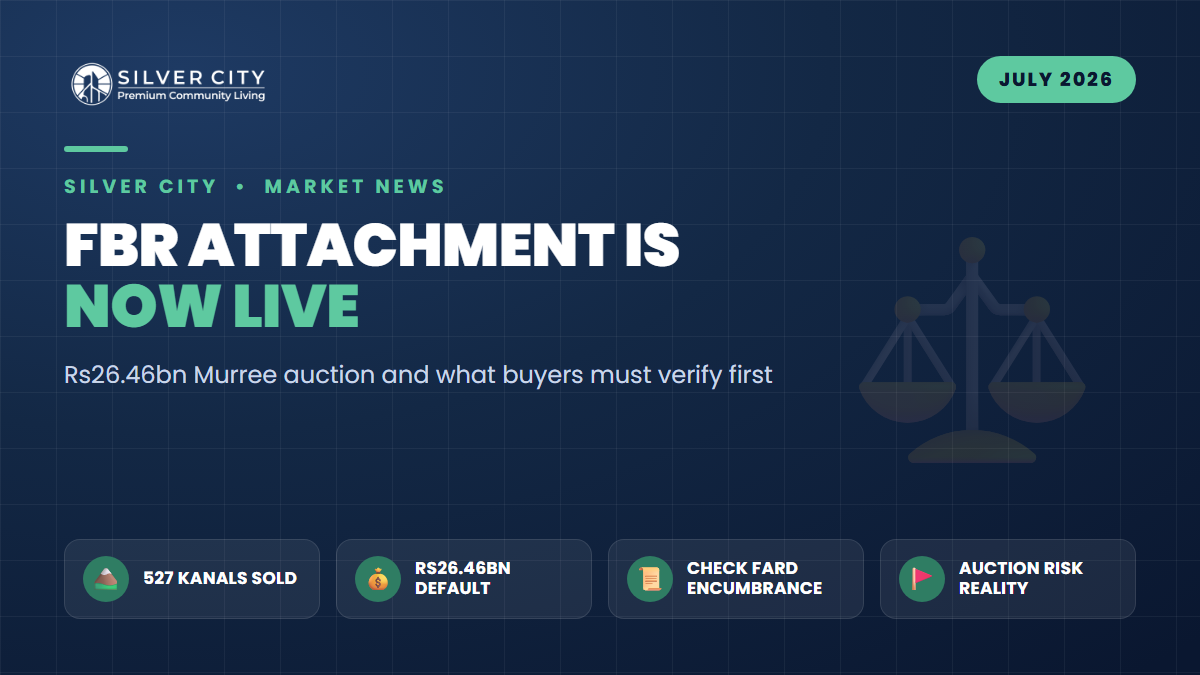
On 27 July 2026, at 11:00am in a conference room at the Large Taxpayers’ Office (LTO) Islamabad: Plot No. 20, Mauve Area, G-9/1, the Federal Board of Revenue did something it has historically threatened far more often than it has executed. It sold somebody else’s land.
The parcel was 527 kanals and 10 marlas at Mauza Kathar Sharqi, Angori Road, Tehsil Murree, District Rawalpindi: Bahria Town Karachi’s entire Murree holding. The recovery target was Rs 26,466,222,636 in defaulted income tax, arising from tax years 2020 and 2022. The land had been attached by FBR back in September 2025. Nearly eleven months later, after a February date was postponed, a 5 March date came and went, and a 7 May attempt failed to convert, the hammer finally fell.
For anyone buying property anywhere in the Rawalpindi-Islamabad corridor, the headline is not “Bahria Town lost land.” The headline is that recovery attachment followed by forced sale is now an operational process, not a paper threat. And that the encumbrance you fail to check is the one that will cost you.
The timeline: why this took eleven months
| Stage | What happened |
|---|---|
| Sept 2025 | FBR attaches the 527-kanal Murree parcel under recovery powers |
| 16 Feb 2026 | First scheduled auction date: postponed |
| 5 Mar 2026 | Auction proceeds; a bidder is declared successful but the sale does not close |
| Spring 2026 | Accountability Court No. III dismisses a contempt application against FBR and NAB; FBR held “at liberty to proceed” in accordance with law |
| 7 May 2026 | Rescheduled auction attempt |
| 27 Jul 2026 | Auction held at LTO Islamabad; parcel sold to a bidder different from the March round |
Note the March-to-July gap. A “successful bid” in Pakistan is not a completed sale. Between the fall of the hammer and a mutation in your name sit balance payment deadlines, confirmation by the recovery officer, competing claims, and often a writ petition. Press reports put the reserve price somewhere in the Rs 1.5-2 billion range against a Rs 26.46bn liability; FBR has not published the confirmed winning bid. Understand what that gap implies: the sale clears a fraction of the debt, so the same taxpayer’s other assets remain exposed, including, potentially, plots that ordinary buyers are being offered today.
Two legal shifts made this possible
First, on the tax side, the Supreme Court’s treatment of developer accounting requires income to be recognised when a sale occurs rather than deferred across years of construction. That single change converted years of “deferred” developer revenue into immediately taxable income. Which is how a bill reaches Rs 26bn. Section 138 of the Income Tax Ordinance, 2001, read with the Income Tax Rules, 2002, then gives the Commissioner the same powers a Civil Court has under the CPC 1908: attach and sell movable or immovable property, appoint a receiver, or even arrest and detain for up to six months.
Second, on the banking side, the Financial Institutions (Recovery of Finances) Amendment legislation passed in 2026 removed the requirement for prior court approval before auctioning mortgaged property. The mechanics now are: three written notices, each 30 days apart; if unpaid after the third, the institution may publish an auction notice; the auction may be held no earlier than 15 business days after publication. Banks may bid themselves, the borrower gets five business days to match the highest bid, and deputy commissioners can be required to take possession and hand it over.
Combine those and you get a supply of genuinely distressed land coming to market near Rawalpindi, and a much larger population of quietly encumbered plots that are being sold privately, at full price, before anyone forces a sale.
How to check a plot for liens, attachment orders and encumbrances
Do these before any token money changes hands. Not after.
- Pull a fresh fard-e-malkiat yourself. Use the PLRA portal at onlinefard.punjab-zameen.gov.pk or the Arazi Record Centre for the relevant tehsil. Do not accept the seller’s photocopy. The record of rights shows registered owners with shares, and critically the encumbrance column, mortgage (rahan), court-ordered freeze, or attachment. A fard dated more than a few weeks ago is not evidence of anything.
- Read the intiqal (mutation) chain, not just the current entry. Ask for the register haqdaran zamin / jamabandi history. A clean current fard sitting on top of a disputed mutation is the single most common trap in Rawalpindi’s rural-converted land.
- Search the Sub-Registrar’s record for registered charges. Mortgages by registered deed and some court orders appear in the registration record even where the revenue record lags. Both must be checked; they are not the same database.
- Check for tax attachment specifically. Attachment under the Income Tax Ordinance is served on the taxpayer and communicated to the revenue authorities for annotation. But annotation can lag. Where the seller is a company or a developer, check FBR’s Active Taxpayer List status, ask directly for a No-Demand or tax clearance position, and treat any developer with known assessment disputes as high risk.
- Verify the scheme’s NOC at source. Use RDA’s own published list of approved private housing schemes for Rawalpindi District, not a marketing agency’s copied chart. There are far more schemes advertising in Rawalpindi than there are approved ones.
- Confirm physical possession and demarcation. Have the plot pointed out on site against the approved layout, and check for occupation, structures, or an access dispute. Paper cleanliness and possession are separate questions.
- Search for pending litigation. Ask for an affidavit of no litigation, and have counsel check the district courts and the relevant Banking Court for suits against the seller by name and CNIC.
Are distressed FBR and bank auction plots actually a bargain?
Sometimes. But the discount is payment for risks that private-market buyers never take on.
| Factor | Distressed auction plot | Approved-society plot |
|---|---|---|
| Headline price | Reserve price often well below market | Market rate, published payment plan |
| Payment terms | Earnest money up front; balance in days/weeks, cash | Instalments over 3-5 years |
| Title warranty | Usually “as is, where is”: no warranty | Allotment/transfer through society records |
| Litigation risk | High: defaulter, other creditors, family claims | Low if NOC and layout are verified |
| Possession | May require separate proceedings to obtain | Handed over on development completion |
| Borrower/defaulter buy-back | In bank auctions, borrower may match your bid within 5 business days | Not applicable |
| Financing | Rarely available; effectively cash-only | Instalments; sometimes bank finance |
| Transaction taxes | Still payable: 236K on purchase, plus provincial stamp duty and registration fee | Same, but predictable and staged |
Run the honest arithmetic. A 25% discount evaporates against two years of litigation, legal fees, blocked capital earning nothing, and the possibility that the sale is set aside entirely. Auction buying suits one specific profile: cash-rich, legally well-advised, able to absorb a total loss on one lot, and buying repeatedly so that the wins average out. If you are placing a single, significant, life-savings bet, the Murree file is a cautionary tale, not an invitation. It took FBR three attempts and a court ruling to complete one sale, and it has the powers of a civil court behind it. You do not.
Frequently Asked Questions
Will a tax attachment always show up on the fard?
No, and this is the core risk. Attachment is effective when ordered and served, but its annotation in the revenue record depends on administrative follow-through and can lag by weeks or months. That is why you check the fard, the Sub-Registrar’s registration record, the seller’s tax standing, and court records, four separate checks, because no single one is complete on its own.
If FBR or a bank auctions a plot, do I get clean title automatically?
Not automatically. The sale transfers what the defaulter had, subject to prior charges. If another bank holds an earlier registered mortgage, or a co-heir has a pending suit, those claims travel with the land. Auction documents are typically “as is, where is” with no title warranty, so the burden of discovering prior encumbrances sits entirely on you.
Can the defaulter reclaim the property after I bid?
Under the 2026 amendments to the Financial Institutions (Recovery of Finances) framework, a housing-finance borrower is given five business days to match the highest bid. In tax recovery, the taxpayer can pay the demand or obtain relief from a court and unwind proceedings. Either way, being the highest bidder is a position, not a title.
What single check catches the most problems?
A fresh fard pulled by you, on the day, plus the mutation chain behind it. If the seller resists that, or produces only an old photocopy, treat it as a decision (walk away) not as a negotiating point.
The quiet alternative
The Murree auction is a useful reminder that Pakistan’s enforcement machinery has genuinely changed gear in 2025-26, and that the cheapest plot on offer is often cheap because someone else’s liability is attached to it. For most buyers in the Rawalpindi corridor, the better risk-adjusted move is unglamorous: a plot in a scheme whose approval you can verify at source, on documented instalments, in a location whose access is already built. On that test, Silver City on Girja Road near the Thalian Interchange: RDA-approved, minutes from Islamabad International Airport with direct motorway access, offering 3.5, 5 and 10 marla and 1 kanal plots on multi-year instalment plans, is exactly the kind of option worth putting on your shortlist alongside anything you are tempted to chase at an auction hall in G-9/1.