On 11 August 2026, the federal cabinet — chaired by Prime Minister Shehbaz Sharif — approved the National Housing Policy 2026, Pakistan’s first comprehensive national housing framework since the 2001 policy roughly a quarter-century ago. Most headlines focused on the push toward vertical apartment living over sprawling plots. But buried in the fine print is a change that touches every single-family home builder in Rawalpindi and beyond: the cabinet ordered that energy-efficiency codes be made a mandatory component of all future construction.
For the thousands of investors who buy a 5-marla plot in an RDA-approved society and build a grey structure to sell or rent, this is not an abstract climate headline. It is a direct input into your construction budget and your floor plan. This article looks past the vertical-versus-plots debate and answers the practical question: what will compliance actually cost you, and how should you design your grey structure to meet it?
What “energy-efficiency codes” actually means
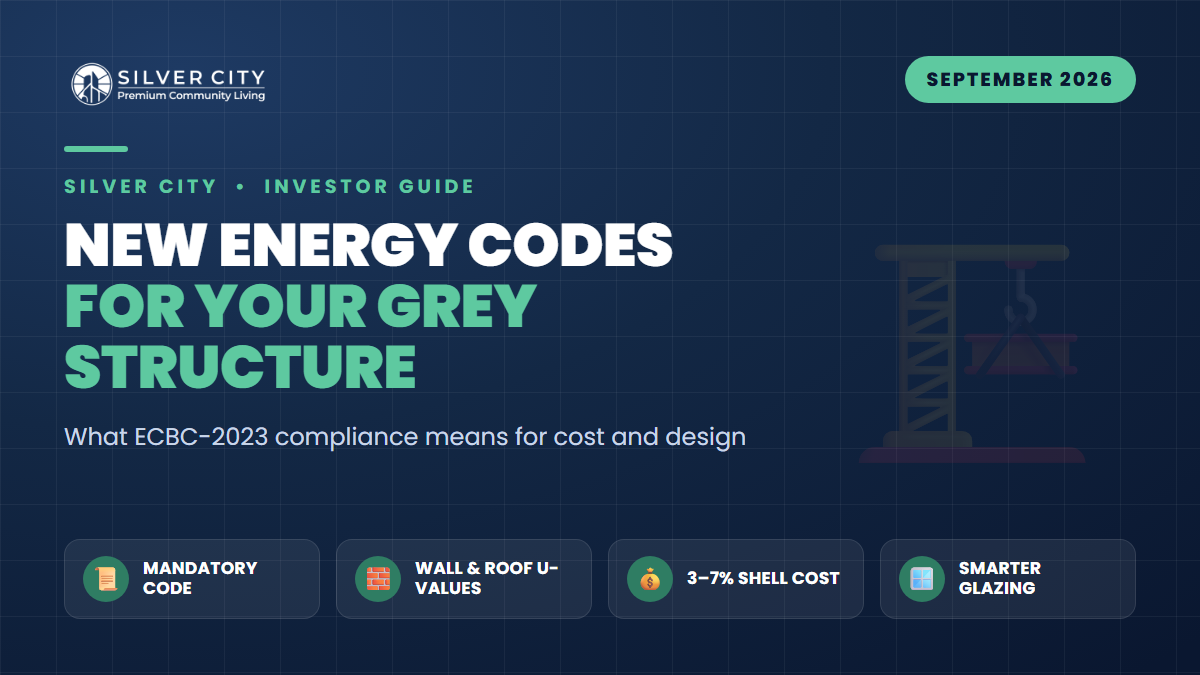
The policy does not invent a brand-new code from scratch. It gives legal teeth to the Energy Conservation Building Code (ECBC-2023), developed by the National Energy Efficiency and Conservation Authority (NEECA) — the former ENERCON — with technical support from Germany’s GIZ. NEECA notified ECBC-2023 as mandatory for new buildings, and the National Housing Policy 2026 now folds those provisions into mainstream housing approvals.
ECBC-2023 is a prescriptive code for the building envelope. In plain terms, it sets maximum heat-transfer limits (U-values) for your walls, roof and windows. The lower the U-value, the less heat crosses the surface — meaning cooler summers, warmer winters and lower electricity bills. The headline targets that matter for a residential shell are:
- External walls: thermal transmittance of about 0.57 W/m²K
- Roof: thermal transmittance of about 0.44 W/m²K (the roof is the biggest heat gain in Rawalpindi’s summers)
- Windows: around 3.5 W/m²K where the window-to-wall ratio stays below 40%
These numbers sound technical, but they translate into a short list of buildable decisions at the grey-structure stage — before a single tile or coat of paint goes on.
The five design decisions that decide compliance
1. Roof insulation
A conventional RCC slab alone will not hit 0.44 W/m²K in our climate. Expect to add a roof insulation layer — extruded polystyrene (XPS) or EPS board, or a screed with insulation plus a heat-reflective treatment. This is the single most cost-effective compliance move because the roof drives the bulk of cooling load.
2. Wall system
Standard 9-inch solid brick struggles to meet 0.57 W/m²K. The two common fixes are switching to AAC (autoclaved aerated concrete) blocks, which insulate far better than fired brick, or building a cavity wall. AAC also builds faster and lighter, partly offsetting its higher unit price.
3. Glazing
Single-pane clear glass in aluminium frames will fail the window target. Low-E or double-glazed units, or at minimum tinted/reflective glass with better frames, bring windows into range. Keeping the window-to-wall ratio under 40% keeps both cost and heat gain down.
4. Orientation and shading
This one is essentially free if you plan early. Research on ECBC-2023 shows optimising building orientation can cut energy use by around 8–9%. Positioning main living spaces away from the harsh west sun, adding chajjas (overhangs) and placing openings for cross-ventilation costs nothing extra at the drawing stage but is expensive to retrofit later.
5. Air-tightness and thermal bridging
Proper plaster, sealed junctions and insulated lintels prevent heat leaks that quietly defeat everything above. Good workmanship, not new materials, carries most of this.
What it costs on a 5-marla grey structure
A double-storey 5-marla grey structure in Rawalpindi in 2026 typically runs in the region of Rs4–5.5 million depending on materials and specification. Energy-code compliance adds an incremental layer — most of it concentrated in the roof, walls and openings. The table below gives realistic ballpark ranges; get quotes locally, as material prices move.
| Compliance item | What it replaces / adds | Indicative added cost (5-marla shell) |
|---|---|---|
| Roof insulation + reflective layer | Bare RCC slab | Rs120,000 – 220,000 |
| AAC blocks or cavity wall | Standard brick masonry | Rs100,000 – 250,000 |
| Improved glazing (double/Low-E) | Single-pane clear glass | Rs80,000 – 200,000 |
| Orientation & shading design | Default plan | Negligible (design stage) |
| Sealing & thermal detailing | Standard finishing | Rs30,000 – 60,000 |
| Total incremental | ~Rs330,000 – 730,000 |
That is roughly a 3–7% uplift on a typical grey-structure budget. It is real money, but it is not the doubling that some builders fear — and much of it is recovered through lower running costs and stronger resale appeal.
The investor case: cost today, value tomorrow
Three reasons the maths favours compliance rather than resistance:
- It becomes the baseline. Once approving authorities enforce the code, a non-compliant shell is a liability at completion and sanction stage. Building to spec now avoids costly rework.
- Buyers pay for lower bills. With electricity tariffs where they are, an “energy-efficient” home that runs cooler on less air-conditioning is a genuine selling point in a competitive market.
- Financing tailwinds. The policy pairs with the expanded Apna Ghar subsidy scheme (loans up to Rs10 million, with Rs220 billion approved and disbursements underway). Green-compliant, affordable homes sit squarely in the segment the state is trying to finance.
A realistic timeline
Enforcement will phase in. The code is federally mandated, but day-to-day building control sits with local authorities such as the RDA. Expect map-approval checklists to add energy provisions gradually rather than overnight. The smart move is to design your next grey structure to the ECBC-2023 envelope targets now, so you are ahead of enforcement rather than scrambling to retrofit.
Frequently Asked Questions
Does the energy code apply to a small 5-marla house?
The National Housing Policy 2026 directs that energy-efficiency codes become a mandatory part of new construction generally. While ECBC-2023’s strictest provisions were framed around larger and conditioned buildings, the policy’s intent is to extend energy-saving design across housing. For a 5-marla investor, the prudent assumption is that envelope standards (roof, walls, glazing) will be checked at approval, so build to them.
How much will compliance add to my grey-structure cost?
Realistically an extra Rs330,000–730,000 on a typical double-storey 5-marla shell — about 3–7%. The roof and wall systems account for most of it. Get local quotes, since AAC block and insulation prices vary between suppliers and seasons.
Can I retrofit energy features after building the shell?
Some, like reflective roof coatings or better curtains, yes. But wall insulation, cavity construction, orientation and correctly sized openings are far cheaper to build in at the grey-structure stage than to add later. Plan for compliance in the drawings, not after the slab is cast.
Will an energy-efficient home actually sell for more?
In today’s high-tariff environment, homes that stay cooler with less air-conditioning carry a clear running-cost advantage that buyers increasingly value. Combined with green-building alignment and subsidy-backed financing, a compliant home is easier to market and defend on price.
The bottom line
The National Housing Policy 2026 turns energy efficiency from a nice-to-have into a compliance requirement, and it lands right at the grey-structure stage where costs are locked in. For a modest, well-planned premium, you get a home that is cheaper to run, easier to sell and future-proofed against tightening rules. If you are choosing where to build, favour a properly planned, RDA-approved society such as Silver City, where regularised approvals and organised development make code-compliant construction far smoother than in unapproved schemes. Building to the new standard today is simply building smart.