What Just Happened in Bahria Town Phase 8
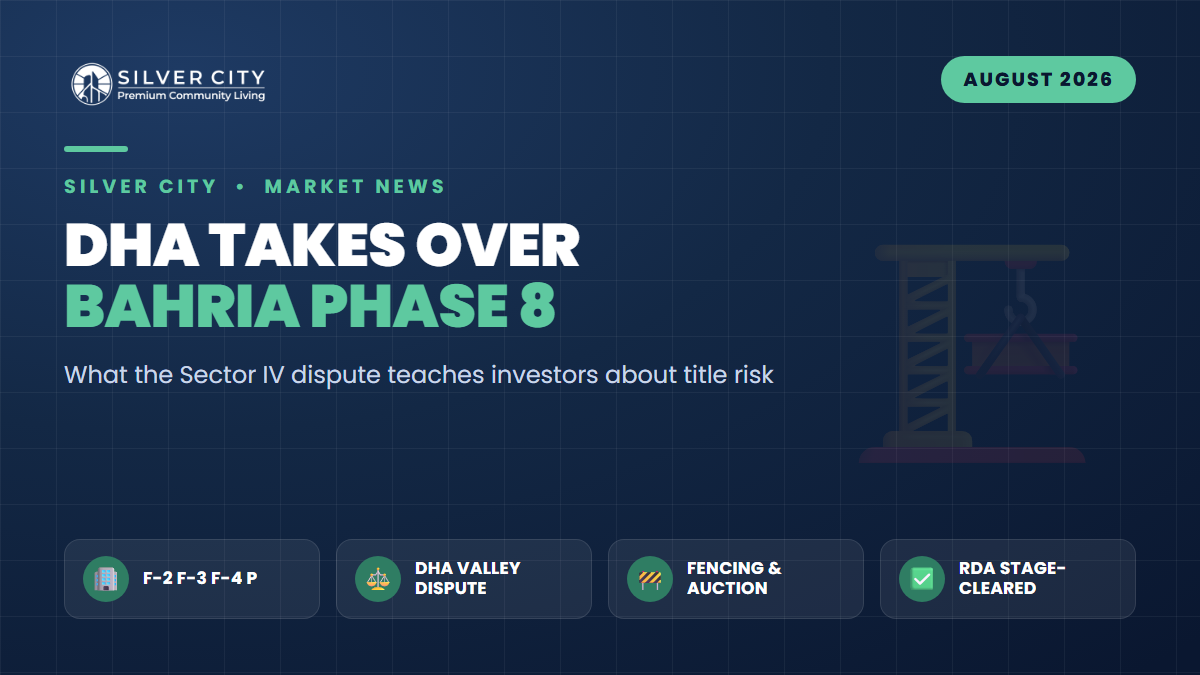
In mid-2026, one of the twin cities’ biggest real-estate stories broke: the Defence Housing Authority (DHA) moved to assume administrative control of several sectors inside Bahria Town Rawalpindi Phase 8 — specifically F-2, F-3, F-4 and the P block — and began rebranding the annexed area as DHA Sector IV. Residents and passers-by reported DHA teams installing heavy concrete slabs, boundary walls and fencing to physically demarcate the new sector, with the fencing most visible along the F-2 and F-3 corridors.
For thousands of allottees, the jurisdiction over their plots appeared to change almost overnight. Importantly, existing owners in possession were not evicted — the immediate change is administrative, not a blanket cancellation of ownership. But the episode is a live case study in counterparty and title risk, and it deserves close reading by anyone deciding where to park hard-earned capital.
The Root Cause: An Old DHA Valley Money Dispute
The takeover did not come from nowhere. It traces back to long-running joint-venture arrangements between DHA and Bahria Town — most notably DHA Valley and DHA Phase 2 Extension. Under those arrangements, Bahria Town was engaged for land acquisition and development works and, per reports, received large sums (billions of rupees) but was accused of failing to deliver its commitments. DHA’s position is that the Phase 8 sectors were effectively surrendered to offset those outstanding dues.
Bahria Town disputes the framing. In its own financial assessment dated 30 June 2023, Bahria claimed roughly PKR 108 billion was outstanding against DHA across the joint ventures — the mirror image of DHA’s claim. Layered on top is a separate auction notice circulated ahead of a sale reportedly scheduled for 17 June 2026, covering land stated to be owned by Ahmad Ali Riaz (son of Malik Riaz) in certain Rawalpindi mouzas, conducted through the office of the Assistant Commissioner Rawalpindi. NAB-linked inquiries into the wider Bahria land matters add further legal weight.
As of writing, no comprehensive joint statement has been issued clarifying the long-term policy for plot owners. That vacuum — not the fence itself — is what puts investors in limbo.
Snapshot: The Sequence of Events
| Element | Detail (as reported, 2026) |
|---|---|
| Sectors affected | Phase 8 F-2, F-3, F-4 and P block |
| New identity | Rebranded “DHA Sector IV” |
| Physical action | Concrete slabs, boundary walls, fencing (F-2/F-3 corridors) |
| Underlying cause | DHA Valley / Phase 2 Extension JV settlement |
| Bahria counterclaim | ~PKR 108 billion outstanding against DHA (per its 30 June 2023 assessment) |
| Auction notice | Land linked to Ahmad Ali Riaz; sale reportedly set for 17 June 2026 |
| Owner status | Possession retained; jurisdiction disputed; no final policy issued |
The Real Problem for Plot Owners: Uncertainty, Not Eviction
Nobody is bulldozing homes. The pain is subtler and, for investors, arguably worse because it freezes value:
- Documentation limbo: Owners hold Bahria-stamped allotment files. Will DHA re-issue, re-verify, or re-number these under Sector IV? No published mechanism yet.
- Transfer and liquidity freeze: When a buyer cannot be sure which authority will honour a transfer, resale demand and prices soften. An asset you cannot cleanly sell is a stranded asset.
- New charges risk: Owners anticipate DHA-style development and monthly maintenance charges — echoing earlier fee adjustments seen in other DHA phases.
- Legal overhang: With a JV dispute, an auction notice and NAB-linked inquiries all unresolved, the timeline to certainty is measured in years, not weeks.
The Investor Lesson: Counterparty and Title Risk Are Real
Strip away the brand names and this is a textbook counterparty-risk event. You did everything a normal buyer does — paid, got a file, held possession — and still ended up exposed because the developer’s balance sheet and legal commitments sat between you and clean title. Two lessons stand out:
- A famous brand is not the same as a clean title. Scale and marketing do not immunise a project from JV disputes, dues, or regulatory action. What protects you is the chain of statutory approval on your specific land.
- Stage clearance beats vibes. A society that has been formally approved and has cleared its planning/development stages with the regulator has already passed the checks that later become disputes elsewhere — land title consolidation, layout sanction, and NOC.
A Practical Due-Diligence Checklist
- Confirm a valid, current RDA (or CDA) NOC — and check the exact mauza/khasra numbers it covers, not just the society name.
- Verify the developer holds clean, consolidated land title for the phase you’re buying — not a joint venture with unresolved obligations.
- Prefer societies where planning stages are cleared and development is visibly on the ground.
- Ask whether the project is entangled in any litigation, NAB inquiry, or inter-authority dispute.
- Get every payment on a company receipt and keep an unbroken documentation trail.
Frequently Asked Questions
Are Bahria Town Phase 8 plot owners losing their plots?
No — reports indicate existing owners in possession retain their properties, and the immediate change is administrative jurisdiction (rebranding to DHA Sector IV), not cancellation of ownership. The uncertainty lies in future documentation, transfers and charges, since no final policy has been jointly published. Owners are advised to preserve all original papers and take legal advice rather than sell in panic.
Why did DHA take over these specific sectors?
The move is linked to old joint-venture settlements — chiefly DHA Valley and DHA Phase 2 Extension — where DHA says Bahria Town failed to meet its obligations against large sums it had received. The Phase 8 sectors are reported to have been surrendered to offset those dues. Bahria disputes this, claiming roughly PKR 108 billion is instead owed to it.
How does this affect property prices in the area?
Legal and jurisdictional uncertainty typically suppresses resale demand and softens prices until a clear policy emerges, because buyers hesitate over transferability. Longer term, some residents expect DHA management to lift infrastructure and security — but that upside is speculative while the dispute is unresolved.
What should this teach a new investor?
Buy the title, not the billboard. Prioritise societies with a verifiable, current regulatory NOC, clean consolidated land, cleared development stages, and no litigation overhang. These are exactly the risks that later turn into “limbo” for someone else.
The Takeaway — and a Safer Lane
The Phase 8 saga is a reminder that in Pakistani real estate, your downside is defined by paperwork and legal standing, not by how big the developer’s name is. For investors who want growth without the counterparty roulette, the sensible filter is simple: buy where the regulator has already signed off. Silver City on Girja Road, near the Thalian Interchange on the Rawalpindi Ring Road / M-2 corridor, is an RDA-approved society (its NOC was granted on 9 October 2018) — a stage-cleared, transparently documented option that lets you invest in the twin cities’ growth story without inheriting someone else’s title dispute. In today’s market, that peace of mind is itself a return.
@@HTML@@