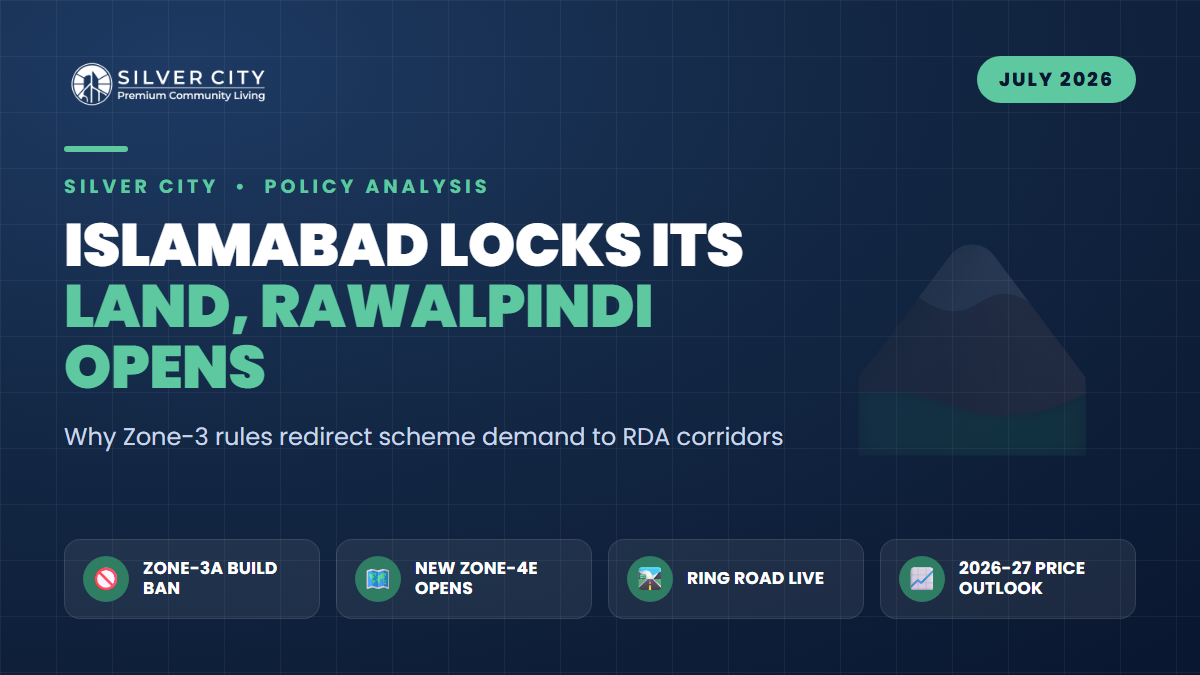
In June 2026 the Capital Development Authority Board approved, in principle, a set of amendments to the Islamabad Capital Territory (Zoning) Regulation 1992 — the 34-year-old instrument that decides where private housing schemes may legally exist inside the federal capital. The stated purpose is conservation: protecting Margalla Hills National Park (MHNP) from the creeping subdivision that has crawled up the foothills for two decades. The commercial consequence is different, and it is the one investors should be reading. Islamabad’s supply of legally developable scheme land just got smaller, and the demand that supply was absorbing has to go somewhere.
What the CDA Board actually approved
Per press reporting of the Board decision, the amendments restructure the zone map around the national park rather than simply tightening building bylaws. The headline items:
- Zone-3 is aligned to the notified boundary of Margalla Hills National Park — a conservation zone, not a development zone.
- Zone-3A is a newly proposed category covering the un-acquired peripheral settlements of Shahdara, Talhar and Gokina. These villages are to be “regulated and contained within defined limits,” with no further construction permitted on privately owned land, and CDA authorised to acquire private land there.
- Zone-1A is a new classification for the belt between the park and the planned residential sectors, extending north of Margalla Avenue up to Sector C-16.
- Zone-4E covers the tract between MHNP and Murree Road / Srinagar Highway, where private developers may operate — but strictly under CDA zoning rules and with prior authority approval.
Process matters here. A six-member committee headed by CDA’s Member Planning & Design was given roughly a fortnight to finalise recommendations, which then travel to the CDA Board, the Ministry of Interior and finally the Federal Cabinet for approval. Until that gazette notification lands, the framework is policy direction — but the construction freeze in the identified pockets is being applied now, which is what turns a planning debate into a live market signal.
The arithmetic of a smaller land bank
Islamabad’s private-scheme capacity was already constrained. Zones 1 and 3 are effectively closed to private schemes; the regulations governing private housing in Zones 2, 4 and 5 were gazette-notified on 7 July 2023, and that trio is where almost all private supply sits. CDA’s own enforcement lists identify roughly 98 illegal or unapproved housing and agro-farming schemes operating in the capital — projects selling files without an approved Layout Plan or NOC. Every enforcement notice against those, plus every acre reclassified into a conservation or acquisition category, removes marketable inventory.
Note the asymmetry: Zone-4E theoretically adds permissible area, but it sits in high-value foothill terrain with heavy scrutiny, approval friction and land costs that price out the mass-market 5- and 10-marla product Pakistani salaried buyers actually purchase. Zone-3A subtracts from exactly the informal, cheap, semi-legal supply that was feeding budget demand. Net effect: capital-city entry prices harden, and affordability moves outward.
| Zone / category | Status after amendments | Private scheme development | Investor read |
|---|---|---|---|
| Zone-3 (MHNP notified area) | Conservation | Barred | No entry; existing files here are high risk |
| Zone-3A (Shahdara, Talhar, Gokina) | Contained + acquisition authorised | Frozen on private land | Avoid; acquisition and demolition exposure |
| Zone-1A (park to sectors, north of Margalla Ave to C-16) | New buffer classification | Restricted | Public-sector sector development only |
| Zone-4E (park to Murree Rd / Srinagar Hwy) | New development category | Allowed with CDA approval | Premium, slow-approval, high ticket size |
| Zones 2, 4, 5 (2023 rules) | Unchanged framework | Allowed with LOP + NOC | Verify LOP and NOC separately |
| RDA district (Chakri, Thalian, Adiala, Girja) | Punjab jurisdiction | Allowed with RDA approval | Where affordable overflow lands |
Why the overflow runs south-west, not north
Demand does not evaporate when a zone closes; it migrates along infrastructure. The Rawalpindi Ring Road — a roughly 38–40 km six-lane corridor with RDA as principal stakeholder — crossed 90% completion in mid-2026 and was targeted to open around 15 June 2026, with the Banth, Chak Beli Khan, Adiala and Chakri interchanges complete or near-complete. The Rs 5 billion Thalian interchange was deferred to a later phase, with the road made operational via a temporary two-way carriageway connection to the motorway — a genuine caveat, not a detail to gloss over.
That single road does three things at once: it links the Chakri, Adiala and Thalian belts to the M-1/M-2 network, it cuts drive times to New Islamabad International Airport, and it converts what was agricultural hinterland into commuter-viable land. Combine that with a CDA map that is closing rather than opening budget supply, and the RDA corridor becomes the default destination for buyers priced out of the capital.
The price gap is the mechanism. Indicative 2026 asking levels (verify before transacting — these move weekly and vary by block, facing and development stage):
| Location | Jurisdiction | Indicative 5-marla asking (2026) |
|---|---|---|
| DHA Margalla Enclave | Islamabad | ~PKR 1.55 crore |
| Sector I-15 (CDA) | Islamabad | ~PKR 75–77 lakh |
| Sector I-16 (CDA, cheapest sector) | Islamabad | from ~PKR 58 lakh |
| Established Chakri Road schemes | RDA | ~PKR 25–45 lakh |
| Girja Road / Thalian belt schemes | RDA | from ~PKR 20 lakh (instalments) |
What this means for approved-society pricing in 2026-27
Three effects are worth positioning for:
- An approval premium, not a location premium. Punjab’s Development Authorities Private Housing Schemes Rules 2021 make marketing, booking, sale or transfer in an unapproved scheme illegal, and RDA has issued repeated public notices. Roughly 82 private housing schemes are approved in Rawalpindi district. As enforcement bites on both sides of the boundary, the spread between an RDA-approved file and an unapproved one in the same field should widen — that spread is the trade.
- Front-loaded infrastructure gains. Ring Road access was largely priced in during construction. Corridor comparables suggest 20–30% five-year appreciation for general corridor land and 40–60% for projects with genuine interchange adjacency. Expect 2026-27 gains to concentrate in schemes with actual road frontage and delivered utilities, not in every project advertising “Ring Road location.”
- Possession beats paper. With capital-city supply tightening, end-user demand (not just file trading) is what carries prices. Schemes with balloted, developed, possession-ready sectors and working water, electricity and sewerage will outperform raw-land phases.
The practical due-diligence list has not changed: confirm the current RDA approval letter for the specific phase you are buying, match the approved layout plan against the site, check that your plot number exists on the sanctioned plan, verify the transfer file at the society office, and confirm FBR and Punjab valuation-table rates before calculating your true acquisition cost.
Frequently Asked Questions
Are the CDA zoning amendments final law yet?
Not fully. The CDA Board approved them in principle in June 2026 and referred them to a six-member committee; the recommendations must clear the Board, the Ministry of Interior and the Federal Cabinet before gazette notification. However, the construction restrictions in the affected peripheral pockets are already being enforced, so the practical effect on land there is immediate.
Does this make Islamabad plots a bad investment?
No — it makes legally clean Islamabad plots scarcer and therefore stronger, while making anything inside Zone-3 or the proposed Zone-3A very risky given the acquisition powers involved. The affordability problem is what pushes new buyers outward, not weakness in the capital’s core.
Is the Rawalpindi Ring Road fully operational, including Thalian?
The main carriageway was reported open from mid-June 2026 after crossing 90% completion, with Chakri, Adiala, Chak Beli Khan and Banth interchanges done. The Thalian interchange was deferred, with a temporary two-way motorway connection in place — so treat “Thalian interchange access” claims in marketing material with care and ask for the current construction status.
How do I verify a scheme is genuinely RDA-approved?
Check RDA’s official approved-schemes list and its public notices on unapproved projects at rda.gop.pk rather than relying on a brochure or dealer screenshot. Ask for the approval letter number and the sanctioned layout plan, and confirm that the specific phase or block you are buying is covered — several corridor projects market land well beyond their approved area.
The bottom line
Islamabad’s zone map is being redrawn in favour of conservation, and the buildable, affordable, legally sellable land inside the capital is shrinking just as the Ring Road makes the Chakri–Thalian–Adiala belt genuinely commutable. That is a textbook setup for RDA-jurisdiction approved societies over 2026-27 — provided you buy approval and development, not adjacency and adjectives. For investors screening that corridor, Silver City on Girja Road near the Thalian interchange is one RDA-approved option worth adding to the shortlist: a gated, developed scheme minutes from New Islamabad International Airport and the I-16 side of the capital, offering 5-marla, 10-marla and 1-kanal residential plots along with commercial and villa options on multi-year instalment plans. As always, verify the current approval status and payment plan directly with the society before you commit.