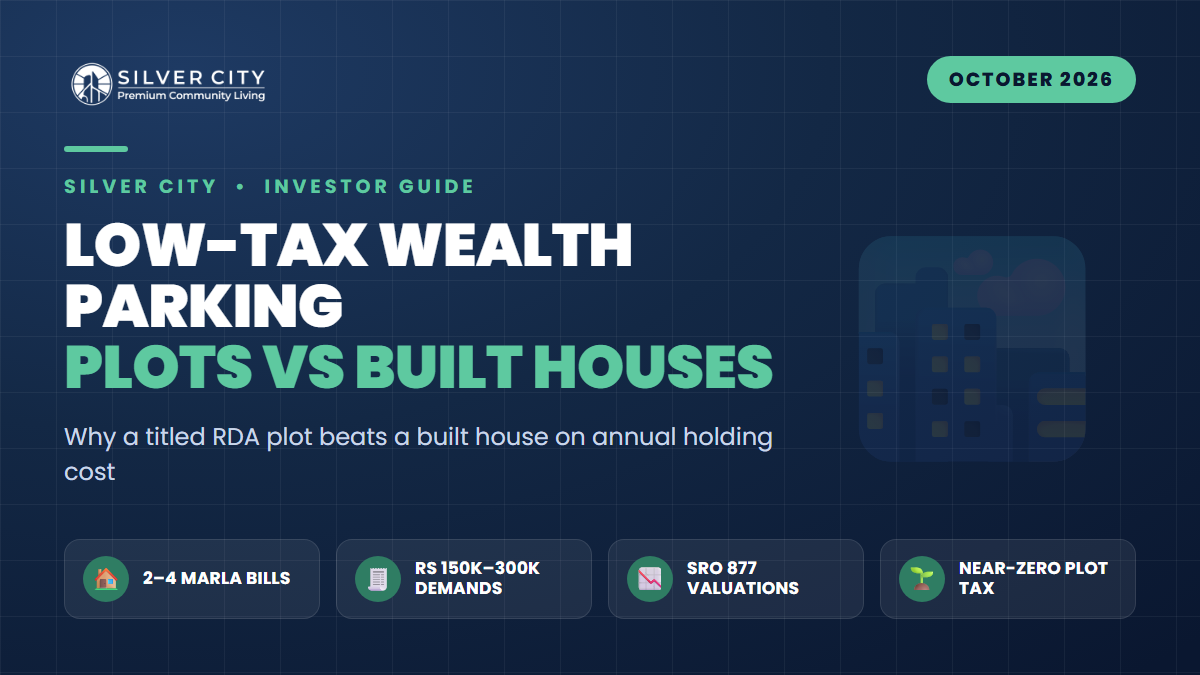
For a quarter of a century, owning a small house in Rawalpindi felt tax-safe. Houses up to five marla sat outside the Punjab property-tax net, and nobody expected a demand notice through the letterbox. That era is over. The Excise, Taxation and Narcotics Control Department has begun issuing property-tax bills of roughly Rs150,000 to Rs300,000 on houses as small as two to four marla in Rawalpindi — and, in cases of non-payment, sealing homes and pursuing owners. For investors parking wealth in Pindi property, the lesson is blunt: a built, occupied house now carries a recurring, rising tax burden that an undeveloped titled plot largely does not.
What Changed: The End of the 5-Marla Comfort Zone
Three forces converged. First, Punjab moved to a capital-value-based property tax regime from 1 January 2025, anchoring the Urban Immovable Property Tax (UIPT) to Deputy Commissioner (DC) valuation tables rather than old rental-value notions. Second, the Rawalpindi DC approved increases in DC valuation rates across most of the district in the rough range of 10% to 25%. Third — and most painful — the department has faced a reported ~50% shortfall in collection from malls, plazas, large houses and major societies, and is making up the gap by dragging small homes back into the net.
The result is that two, two-and-a-half, three and four-marla homes that were effectively exempt are now receiving five- and six-figure demands. A new, higher valuation base multiplied by higher rates turns a modest house into a meaningful annual liability — one you pay every year, whether or not the property earns you a rupee.
FBR’s SRO 877(I)/2026 and the DHA Transfer Picture
Separately, the Federal Board of Revenue issued SRO 877(I)/2026 on 19 May 2026, revising the notified valuation tables for Rawalpindi under Section 68(4) of the Income Tax Ordinance, 2001. Rawalpindi values are now stated per square foot (unlike Lahore’s per-marla tables) and cover DHA Phases I–V and DHA Valley.
A common myth is that the SRO simply “hiked” DHA values. In reality it was a mixed revision: several high-value residential brackets were actually trimmed by about 10–35%, while the notified base for built structures was formalised. Even so, the absolute numbers remain large. Representative figures from the order include:
| DHA Rawalpindi bracket (SRO 877/2026) | Notified value (per sq ft) |
|---|---|
| DHA Phase II — commercial open plot | ~Rs 17,677 |
| DHA Phase I — commercial land | ~Rs 15,427 |
| DHA Phase II — residential plot | ~Rs 2,878 |
| Built structure — residential (various phases) | ~Rs 735 |
| Built structure — commercial (various phases) | ~Rs 1,470 |
| DHA Valley — residential | ~Rs 466 |
The key investor insight: a built house is taxed on land value plus the superstructure value. That higher combined base feeds both the one-off transfer taxes and, through DC tables, the recurring annual property tax. A bare plot is taxed on land alone — and an undeveloped plot inside a society still under development is, in most cases, not yet an annual-tax target at all.
Transfer Friction: Built House vs Titled Plot
When a property changes hands, the buyer pays advance tax under Section 236K and the seller under Section 236C. Under the Finance Act 2026-27, filer rates were simplified and cut, while non-filer bands under the Tenth Schedule stayed punitive:
| Advance tax | Filer | Non-filer |
|---|---|---|
| 236K — buyer (purchase) | ~1.25% | ~10.5%–18.5% (by value slab) |
| 236C — seller (sale) | ~2.75% (flat) | ~11.5% |
Because these percentages apply to the notified value, a high-base built house in DHA generates far larger rupee friction than a modestly valued titled plot — even at identical percentage rates. Add stamp duty and registration (~2% combined) and the gap widens further.
Side-by-side holding and transfer cost
| Cost line (filer basis) | Built DHA ~5-marla house | Undeveloped titled RDA 5-marla plot |
|---|---|---|
| Typical notified value | ~Rs 11,000,000+ | ~Rs 2,500,000 |
| 236K (buyer, ~1.25%) | ~Rs 137,500 | ~Rs 31,250 |
| 236C (seller, ~2.75%) | ~Rs 302,500 | ~Rs 68,750 |
| Stamp + registration (~2%) | ~Rs 220,000 | ~Rs 50,000 |
| Annual UIPT (property tax) | Rs 150,000–300,000 demands now seen | Near-zero while vacant/under development |
The annual line is where the thesis lives. Under the Punjab Urban Immovable Property Tax Act, 1958, a vacant plot handed over for the first time is exempt for up to two years, un-utilised land is assessed at a nominal annual value (around 0.20%), and a single residential plot not exceeding five marla carries a long-standing exemption (subject to category-A area caveats). In practice, a titled 5-marla plot in a developing RDA society is a low-maintenance, low-tax store of value — you are not feeding the annual UIPT machine the way a built, occupied house now does.
Why “Wealth Parking” in a Titled Plot Makes Sense Now
- Negligible annual holding cost — no five-figure UIPT demand landing each year.
- Lower transfer friction — a smaller notified base means smaller 236K/236C/stamp outflows on both entry and exit.
- No superstructure to tax, insure or maintain — land does not depreciate, leak or need repairs.
- Cleaner liquidity — a titled, NOC-cleared plot is simpler to sell than a bespoke house.
- Capital appreciation on development — well-located societies near motorway interchanges tend to re-rate as infrastructure matures.
The trade-off is honest: a plot earns no rent, and if you build, you inherit exactly the tax profile this article warns about. So this is a strategy for parking and growing capital, not for generating yield.
Frequently Asked Questions
Are 2–4 marla houses in Rawalpindi really getting Rs150,000–300,000 tax bills?
Yes. Following the shift to a capital-value regime and higher DC valuations, Excise & Taxation has issued demands in that range on small homes that were previously treated as exempt, and has sealed properties over non-payment. If you receive a bill you believe is wrong, you can contest the assessment — check the valuation basis, category, and any applicable exemption before paying.
Did SRO 877(I)/2026 increase or decrease DHA Rawalpindi values?
Both, depending on the bracket. The 19 May 2026 order revised the per-square-foot tables and actually trimmed several high-value residential brackets by roughly 10–35%, while standardising built-structure rates. The notified base for a built house nonetheless remains high relative to a bare plot.
Is an undeveloped titled plot completely free of property tax?
Not permanently, but close to it in practice. Newly handed-over vacant plots enjoy a roughly two-year exemption, un-utilised land is assessed at a nominal rate, and a single residential plot up to five marla carries an exemption subject to area-category rules. The recurring burden only becomes significant once you build and occupy.
What should a filer check before buying a plot as a wealth-parking play?
Confirm the society’s regulatory approval (RDA/NOC status), verify the plot is titled and transferable, confirm you are on the Active Taxpayers List to access filer rates, and model your exit-side 236C before committing. Buying as a non-filer can multiply your transfer tax several times over.
The Takeaway
Rawalpindi’s tax landscape has flipped the old intuition: a built, titled house is now the high-friction asset — recurring UIPT demands on top of transfer taxes computed on a land-plus-structure base — while a titled, undeveloped plot sits in a far lighter tax lane. For investors whose goal is to park and compound capital rather than earn rent, a 5-marla titled plot in a well-located, approved society is worth serious consideration. On that score, Silver City — an RDA-approved, NOC-cleared society on Girja Road near the Thalian interchange off the M-2, with 5-marla plots in the ~Rs2.55–2.75 million range and multi-year instalment plans — is one such option worth evaluating against your own numbers and professional tax advice.