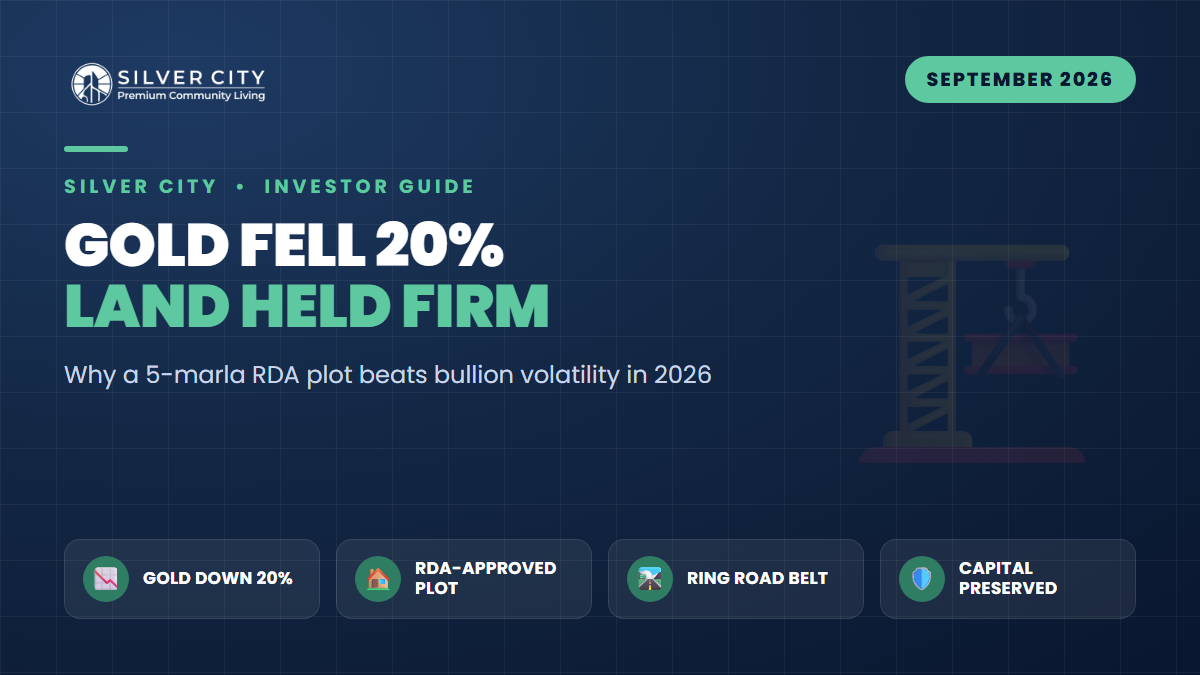
For most of 2024 and 2025, the “safe” money in Pakistan poured into gold. Then came 2026’s reality check. After peaking at an all-time high of Rs572,862 per tola on 29 January 2026, gold has retraced sharply — trading around Rs457,000 per tola by mid-September 2026. That is a drawdown of roughly Rs115,000 a tola, or about 20%, in under eight months.
Here is the counter-intuitive part: this pullback does not break the case for rotating out of bullion and into RDA-approved land. It strengthens it. The exact volatility that just wiped one-fifth off a gold holding is the volatility a physical, registered 5-marla plot in a society like Silver City is designed to sidestep.
The Numbers: What the 2026 Drawdown Actually Looked Like
Gold’s 2026 ride has been a textbook example of why single-asset concentration is risky. The table below tracks the round trip using verified local rates.
| Date | Gold (per tola) | Change from peak |
|---|---|---|
| 21 Jan 2026 | ~Rs500,000 (crossed 5-lac mark) | Approaching peak |
| 29 Jan 2026 (record) | Rs572,862 | 0% (all-time high) |
| 12 Sep 2026 | ~Rs457,136 | −Rs115,726 (≈ −20%) |
An investor who bought a single tola at the January top is sitting on an unrealised loss of over Rs115,000 today. Someone holding 10 tolas is down more than Rs1.15 million on paper. That is real money — and it evaporated without any transaction, any fraud, and any bad decision beyond timing.
Why Bullion Swings and Registered Land Does Not
Gold prices in Pakistan are set by two forces the local investor cannot control: the international spot price (in US dollars) and the PKR/USD exchange rate. When global bullion corrects or the rupee firms up, your tola loses value overnight — literally by the morning rate. There is no floor tied to anything you can touch or use.
An RDA-approved 5-marla plot behaves differently for structural reasons:
- Utility floor: land can be built on, rented, or lived in. That end-use demand puts a practical floor under price that a metal bar simply does not have.
- Local, illiquid pricing: plot values re-rate slowly on the back of development milestones and demand — not on a minute-by-minute global ticker.
- Development uplift: as roads, utilities and possession progress, the plot’s value tends to step up, independent of any commodity cycle.
- Rupee hedge without the whipsaw: property still tracks inflation over time, but without gold’s sharp two-way swings.
The Rotation Math: One Peak Tola vs. Instalment Land
Consider an investor who sold roughly five tolas near the January peak (about Rs2.86 million) and rotated into a 5-marla plot in the Rawalpindi Ring Road belt, where RDA-approved 5-marla plots sit in the Rs2.55–2.75 million band. The comparison below is illustrative, not a guarantee — but the logic is what matters.
| Factor | 5 Tolas of Gold (held from Jan peak) | 5-Marla RDA Plot (rotated in Jan) |
|---|---|---|
| Entry value | ~Rs2.86 million | ~Rs2.55–2.75 million |
| Mid-Sep 2026 position | ~Rs2.29 million (−20%) | Broadly stable / firm |
| Volatility | High (daily rate moves) | Low (milestone-driven) |
| Income potential | None | Future rent / build |
| Payment flexibility | Full amount upfront | 3–4 year instalments available |
The gold holder preserved liquidity but ate a 20% mark-to-market loss. The land rotator preserved capital — and, on an instalment plan, did not even need the full lump sum on day one.
Why the Ring-Road Belt Adds a Second Engine
Silver City sits on Girja Road near the Thalian Interchange, directly in the Rawalpindi Ring Road (RRR) corridor. This matters because the plot is not just avoiding gold’s volatility — it is positioned for infrastructure-led appreciation. As the Ring Road moves toward completion, corridors like this historically re-rate as access and commercial activity improve. Bullion has no equivalent tailwind; it is entirely at the mercy of global sentiment.
Key checkpoints before you rotate
- Confirm the plot is RDA-approved and the specific block/number falls inside the approved layout.
- Verify the payment plan (down payment, instalment count, possession charges) in writing.
- Match your horizon: land rewards a 3–5 year hold, not a quick flip.
- Keep some liquidity — property is less liquid than a tola you can sell same-day.
Frequently Asked Questions
Does gold’s 20% fall mean I should sell all my gold?
Not necessarily. Gold still plays a role as a liquid, portable hedge. The point is concentration risk: if a large share of your wealth is in bullion, the 2026 drawdown shows how quickly one-fifth of it can vanish. Rotating a portion into registered land diversifies you into an asset with a utility floor and far lower volatility.
Could a 5-marla plot also fall 20% like gold did?
A sharp, simultaneous 20% drop is far less likely for an RDA-approved plot in a developing corridor, because pricing is local, illiquid, and tied to real end-use and development progress rather than a global ticker. Land is not risk-free — poor location or unapproved projects can stagnate — but its risk profile is fundamentally steadier than bullion’s.
Why RDA-approved specifically?
RDA (Rawalpindi Development Authority) approval is the single biggest protection against the two things that actually destroy plot value in Pakistan: legal disputes and no-development limbo. An approved layout means the society is recognised, planned, and far more likely to deliver utilities and possession — the very milestones that drive price uplift.
Is now a bad time because gold might rebound?
Timing gold’s bottom is exactly the game that just cost January buyers 20%. The stronger position is to hold an asset whose value does not depend on calling the next global swing. If gold rebounds, great — your remaining holding benefits. If it falls further, your land capital is insulated.
The Bottom Line
Gold’s slide from Rs572,862 to around Rs457,000 per tola is not a reason to abandon the rotation thesis — it is the live case study that validates it. The pullback proved that bullion can shed 20% of your capital in months, while a physical, RDA-approved plot in a growth corridor holds its ground and carries genuine upside from development. For investors weighing that rotation, an RDA-approved 5-marla plot in Silver City, on the Ring Road belt near Thalian with flexible 3–4 year instalment plans, is a concrete option worth putting on the shortlist — one designed to preserve capital exactly when the shiny alternative did not.