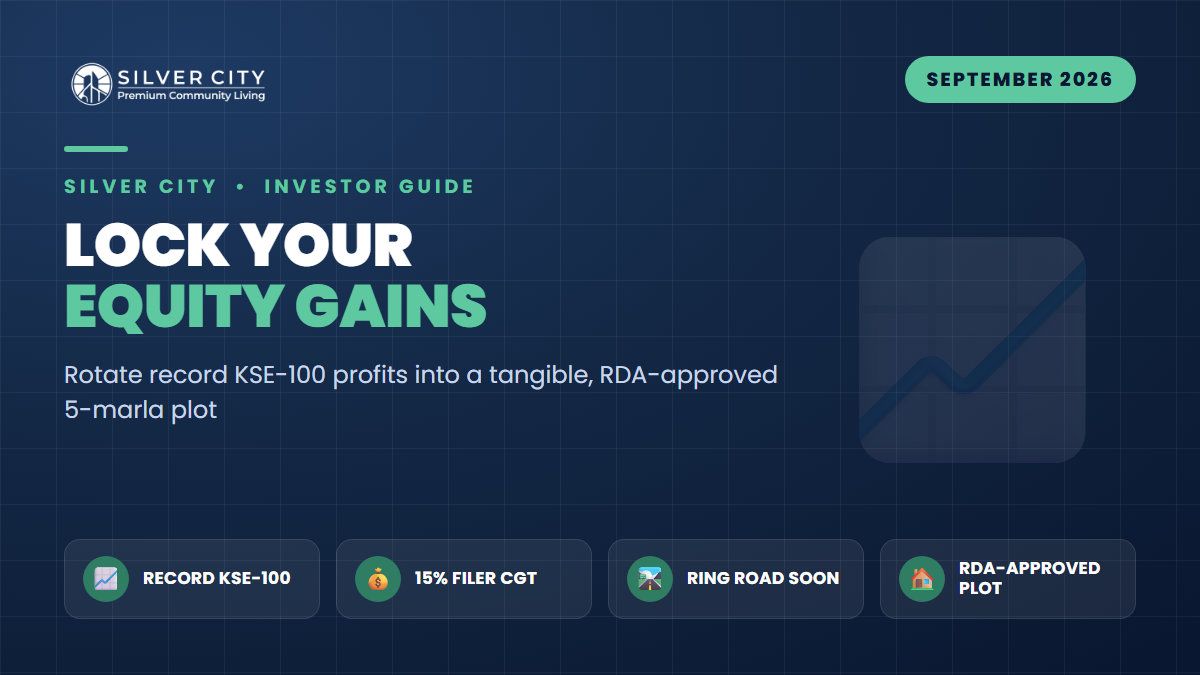
The KSE-100 has done what few indices in the world have managed this cycle: it has printed record after record, brushing the 190,000 mark in 2026 after an all-time high near 189,500 and an intra-year peak above 191,000. If you rode that rally, congratulations — but paper gains are not realised gains. The single most common mistake in a runaway bull market is confusing a screen full of green with money in the bank.
This guide is a disciplined, unemotional playbook: how to book a portion of your equity profits, manage the tax, and rotate a slice of that capital into something you can stand on — an RDA-approved 5-marla residential plot on the Rawalpindi Ring Road belt, ideally before the corridor formally opens.
Why book profits now, not later
Nobody rings a bell at the top. The KSE-100’s run has been driven by falling policy rates, a stabilising rupee, IMF-anchored macro discipline and cheap valuations that have since normalised. Those are real tailwinds — but at record levels, the margin of safety shrinks and volatility rises. Profit booking is not a bet that the market will crash; it is simply the act of converting some of your outperformance into a more stable, uncorrelated asset.
Rotating into land is attractive for three Pakistani-specific reasons: real estate is a traditional inflation hedge, it is largely uncorrelated with equity swings, and a physical plot cannot be diluted, delisted or margin-called. The catch is regulatory risk — which is exactly why approval status matters more than price.
The profit-booking rules
- Trim, don’t liquidate. Consider harvesting 20–40% of your equity book rather than exiting entirely. Let winners run with a trailing plan; take the rest off the table.
- Sell into strength. Scale out in tranches on up-days rather than dumping in a panic on a red one.
- Respect the tax clock. For securities acquired on or after 1 July 2024, active taxpayers (filers) pay a flat 15% Capital Gains Tax, deducted automatically by NCCPL through your broker at settlement. Non-filers face materially higher rates. Being on the FBR Active Taxpayers List before you sell is the cheapest optimisation available.
- Keep a cash buffer. Never deploy 100% of booked profit into an illiquid asset. Retain liquidity for instalments and emergencies.
The Ring Road timing window
The Rawalpindi Ring Road (RRR) is a roughly 38.3 km corridor that reroutes GT Road traffic and stitches together the western Chakri–Thalian growth node. As of mid-September 2026, the main carriageway is fully carpeted, four of five interchanges are complete, and civil works exceed 90%. The project has, however, slipped past several deadlines — including an August 2026 target — and is now awaiting a formal inauguration date from the Punjab Chief Minister. The larger Thalian interchange upgrade has been deferred to a later NHA phase.
For an investor, that gap between “physically ready” and “formally inaugurated” is the opportunity. Land priced on a “not yet open” narrative typically re-rates once traffic actually flows. Buying a titled, approved plot on the interchange belt before the ribbon is cut is the classic pre-completion play — provided the society itself carries no regulatory baggage.
A simple 90-day rotation timeline
| Phase | Action | Why it matters |
|---|---|---|
| Weeks 1–2 | Confirm ATL/filer status; tag lots by purchase date | Locks in the 15% filer CGT rate; avoids non-filer penalty |
| Weeks 2–4 | Trim 20–40% of equities in tranches on up-days | Realises gains without market-timing the exact peak |
| Weeks 4–6 | Shortlist RDA-approved societies; verify NOC directly with RDA | Eliminates the biggest risk in Rawalpindi land — approval |
| Weeks 6–10 | Site visit, verify plot location, negotiate, book | Confirms the plot is on the interchange belt, not a map |
| Weeks 10–13 | Retain cash buffer; set up instalment schedule | Keeps you liquid while the corridor matures |
Why a 5-marla plot, and roughly what it costs
The 5-marla category is the sweet spot for rotated equity capital: it is the most liquid resale size, qualifies for government low-cost financing schemes, and suits both end-users and investors. On the Ring Road belt, RDA-approved 5-marla plots in 2026 typically trade in the Rs 2.55–2.75 million range, with instalment structures spread over roughly three to four years and modest down payments.
| Item | Typical 2026 figure (5-marla, RRR belt) |
|---|---|
| Approved plot price | Rs 2.55–2.75 million |
| Instalment tenor | ~36–48 months |
| Entry booking (smaller categories) | ~Rs 200,000–315,000 |
| Filer CGT on booked equity gains | 15% (deducted at settlement) |
Instalment plans let you keep a larger cash reserve invested or liquid while still securing today’s price — useful if you believe the corridor’s opening will lift belt values.
Due diligence: the non-negotiables
- Verify the NOC yourself. Ask for the RDA approval reference and confirm it on the RDA’s own list — do not rely on a brochure.
- Match the plot to a physical location. Insist on a site visit and confirm the plot number exists on the ground within the approved layout.
- Check developer track record. Delivery history, development pace and possession status matter more than glossy renders.
- Read the payment plan in full. Understand surcharges, transfer fees, development charges and possession conditions before signing.
Frequently Asked Questions
Should I sell all my shares and move into property?
No. A sensible rotation trims a portion — commonly 20–40% — of a portfolio that has run hard, while keeping quality positions and a cash buffer. The goal is diversification and locking realised gains, not abandoning equities entirely. Land is illiquid, so never over-commit.
How much tax will I pay when I book my equity profits?
For securities bought on or after 1 July 2024, filers on the FBR Active Taxpayers List pay a flat 15% Capital Gains Tax, collected automatically by NCCPL via your broker at settlement and declared in your annual return. Non-filers pay significantly more, so confirm your ATL status before you sell.
Is buying before the Ring Road opens actually safer?
Buying pre-inauguration can capture upside as the corridor re-rates once traffic flows — but only if the plot is on an approved, well-located society on the belt. An unapproved file at a “cheap” price carries regulatory risk that can wipe out any timing advantage. Approval first, price second.
Why 5-marla specifically?
Five-marla plots are the most liquid resale size in the Rawalpindi–Islamabad market, are eligible for low-cost housing finance, and require less capital than larger categories — making them ideal for capital rotated out of equities in tranches.
The bottom line
Records are a reason to be disciplined, not euphoric. Book a measured slice of your KSE-100 gains, manage the 15% filer CGT cleanly, and rotate into a tangible, verified asset before the Ring Road’s opening re-rates the western belt. Among the options on that corridor, Silver City — an RDA-approved (NOC-cleared) scheme on Girja Road near the Thalian node, offering 5-marla plots on multi-year instalments — is one worth adding to your shortlist and verifying firsthand. Confirm the approval, walk the site, and let a real deed do what a stock certificate cannot: sit outside the market’s next mood swing.
@@END@@