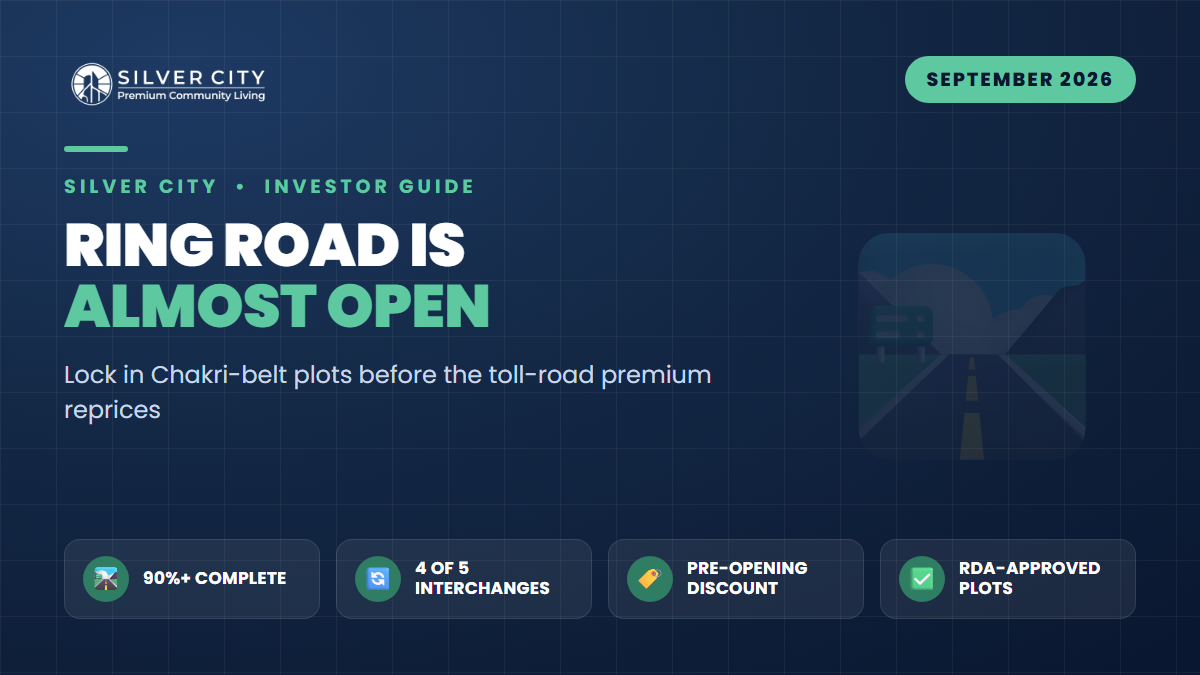
For three years, the Rawalpindi Ring Road (RRR) has been the single biggest catalyst hanging over the Rawalpindi–Islamabad property map. As of September 2026, that catalyst is no longer a promise on a feasibility PDF — it is asphalt on the ground. More than 90% of civil work is complete, all 38-plus kilometres of the main carriageway have been carpeted, and four of the five interchanges are finished. Punjab Chief Minister Maryam Nawaz is expected to inaugurate the corridor at the GT Road (Banth) interchange once a firm date is locked.
For investors on the western Chakri–Thalian growth belt — where RDA-approved schemes like Silver City sit — this is the phase that historically compresses the buying window. The “under-construction discount” that has kept approved plots cheap is the discount that disappears at the ribbon-cutting. Below is an accurate, current read on where the project stands and how to think about timing before the toll-road premium reprices the belt.
Where the project actually stands
The RRR is a roughly 38.6-km, six-lane, controlled-access expressway looping from the Banth interchange on GT Road (N-5) near Rawat, west through Chak Beli Khan, Adiala Road and Chakri Road, terminating at the Thalian interchange beside the M-2 Motorway and New Islamabad International Airport. The revised project cost has climbed to around Rs 53 billion.
The honest picture is one of near-completion with two loose ends. Four interchanges are done; the Thalian interchange — the one that plugs the corridor straight into the M-2 and the airport — sits under a separately budgeted Phase II (reported at roughly Rs 5 billion) with its own timeline. The project also blew through a series of deadlines (December 2025, and then March, May, June and an August 14, 2026 target), with tolling infrastructure and an NOC controversy over a roadside service area cited among the hold-ups. Investors should price in that the formal inauguration could still slip by weeks.
| Interchange | Connects to | Status (Sep 2026) |
|---|---|---|
| Banth (GT Road / N-5) | GT Road, Islamabad via Faizabad | Complete |
| Chak Beli Khan | Chak Beli Khan Road | Complete |
| Adiala Road | Adiala Road corridor | Complete |
| Chakri Road | Chakri Road, airport corridor | Complete |
| Thalian (M-2) | Lahore–Islamabad Motorway, airport | Phase II — pending |
Why the discount vanishes at ribbon-cutting
Under-construction pricing exists to compensate a buyer for risk and for time. On a mega-project like the RRR, three specific discounts are stacked into today’s rate:
- Execution risk discount: the market has repeatedly doubted whether the road would finish. Every missed deadline kept a “will it actually open?” haircut in the price. Completion erases that doubt — and the haircut with it.
- Access-not-yet-live discount: a plot 10 minutes from a finished interchange commutes differently than one next to a construction site. When traffic starts flowing, the location’s real utility is priced in, not estimated.
- Illiquidity discount: pre-completion belts trade thin. Once the corridor is live, buyer volume rises, listings move faster, and sellers stop discounting to exit.
Historically in this region — think DHA extensions, the M-2 corridor, and Islamabad’s Srinagar Highway build-outs — the sharpest single re-rating on approved land has clustered around the operational milestone, not the announcement. The announcement is already largely in the price. The ribbon-cutting, and the first months of live tolled traffic, are what tend to reset the floor.
Why the Chakri–Thalian belt is structurally advantaged
Not every point on a 38-km loop benefits equally. The western belt around Chakri and Thalian carries a specific edge: it is the airport-facing end. Chakri Road interchange is complete and functions as the access point toward the New Islamabad International Airport corridor, while Thalian ties into the M-2. That means dual connectivity — ring road plus motorway plus airport — concentrated at one end of the loop.
Silver City is an RDA-approved (NOC-cleared) housing scheme on Girja Road near the Thalian interchange, squarely inside this western node. Its relevance to the pre-completion thesis is straightforward: it is approved land (so the regulatory risk that plagues many Rawalpindi files is already resolved) sitting on the interchange belt that gains the most from the RRR going live.
Silver City indicative pricing and payment structure
Silver City offers 3.5, 5 and 10 Marla and 1 Kanal residential plots, typically on a four-year (48-month) installment structure with a booking-plus-confirmation down payment. Indicative figures circulating in the market in 2026 are below. Treat these as a starting point — always confirm the current plan, category (residential vs. commercial), and any development charges directly with the developer before booking.
| Plot size | Indicative total (PKR) | Typical booking + confirmation | Monthly installment |
|---|---|---|---|
| 5 Marla | ~2.55m – 2.75m | ~15% + 15% | ~30,000 × 48 |
| 10 Marla | ~5.0m – 5.35m | ~15% + 15% | ~60,000 × 48 |
| 1 Kanal | ~10.2m – 10.35m | ~15% + 15% | ~120,000 × 48 |
How to lock in before the reprice — a practical checklist
- Verify the NOC yourself. Confirm the scheme’s approved status and the specific block/phase on the RDA record — don’t rely on a marketing brochure. Approved land is the whole point of this play.
- Buy proximity to a completed interchange. Chakri and Thalian access is the value driver here; a plot’s distance and road linkage to the interchange matters more than a slightly bigger size further out.
- Prefer developed or fast-developing blocks. A possession-ready plot captures the reprice immediately; a file in an undeveloped block still carries its own timeline risk.
- Use the installment window as leverage. A four-year plan lets you enter at today’s rate while paying over time — but read the transfer, surcharge and development-charge clauses.
- Budget for the Thalian caveat. Full airport/M-2 connectivity depends on the pending Phase II interchange. Underwrite your return on what is open now, and treat Thalian as upside.
Frequently Asked Questions
Is the Rawalpindi Ring Road actually open yet?
As of September 2026, no — it is over 90% complete with all-stretch asphalt laid and four of five interchanges finished, but the formal inauguration by CM Maryam Nawaz has not taken place. Tolling work and the Thalian interchange remain the main outstanding items, and past deadlines have repeatedly slipped, so allow for the opening to move by weeks.
Why does completion push plot prices up?
Pre-completion prices carry discounts for execution risk, not-yet-live access, and thin liquidity. When the road opens and tolled traffic starts, those discounts unwind together, which is why the biggest single re-rating on approved land tends to cluster around the operational milestone rather than the earlier announcements.
Is Silver City near the Ring Road, and is it approved?
Silver City is an RDA-approved (NOC-cleared) scheme on Girja Road near the Thalian interchange, on the western Chakri–Thalian belt of the corridor — the airport-facing end that benefits from ring road, motorway and airport connectivity converging in one node.
What’s the main risk to this thesis?
Timing and the Thalian interchange. The inauguration could slip further, and full M-2/airport connectivity depends on Phase II being finished. Mitigate by verifying the NOC, buying near a completed interchange, and underwriting returns on the access that is already live.
The bottom line
The RRR has crossed from “coming soon” to “nearly here.” Once the corridor is inaugurated and tolled traffic begins, the pre-completion discount that has kept approved western-belt land affordable is the discount most likely to disappear first. For investors who want approved, installment-friendly exposure to the Chakri–Thalian node, Silver City is one RDA-approved option genuinely worth evaluating during this closing window — provided you verify the NOC, the block, and the current payment plan before you commit.