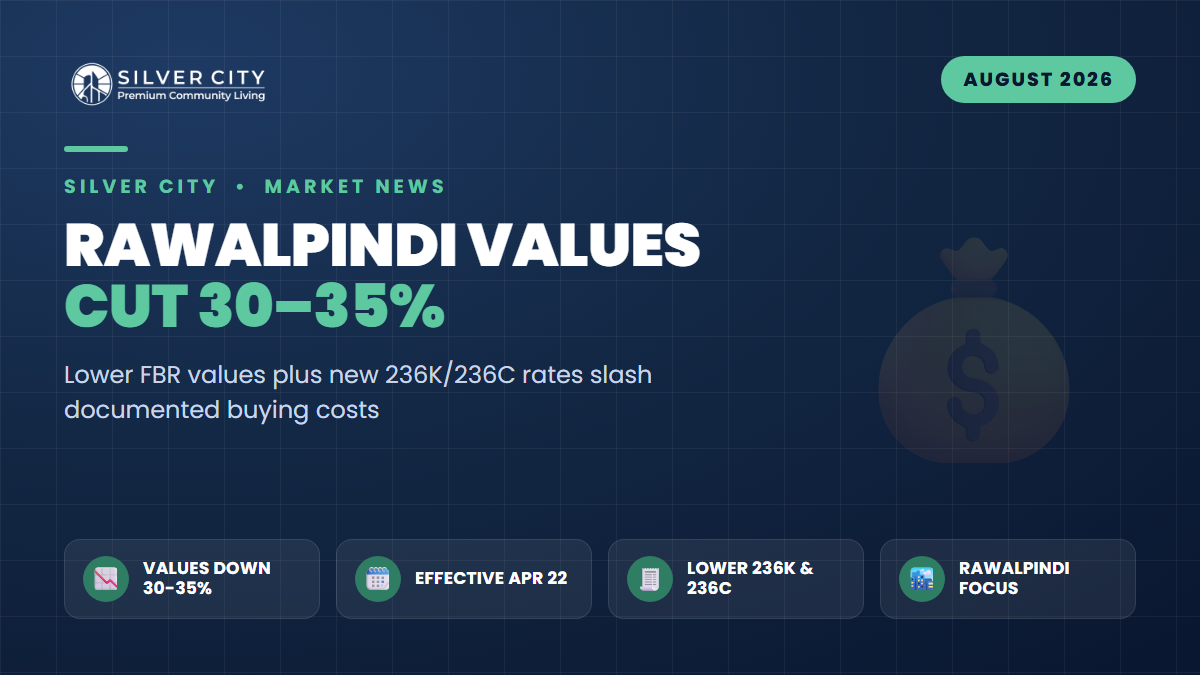
For years, the biggest complaint against documented property buying in Pakistan was simple: the tax bill was brutal. Two policy moves in 2026 have quietly changed that maths — and Rawalpindi investors are among the biggest winners. First, the Federal Board of Revenue (FBR) revised down the fair-market valuations of immovable property by 30% to 35% in Islamabad, Rawalpindi, Faisalabad, Sialkot, Multan, Bahawalpur and Gujranwala, effective 22 April 2026. Second, the IMF-approved Finance Act 2026 cut and simplified the advance taxes under Sections 236K and 236C into single flat rates for filers.
Because property tax is charged as a percentage of the FBR value, cutting the value and cutting the rate compounds. This article recalculates the real transfer-and-gain-tax bill on a 5-marla plot so you can see exactly how much cheaper a fully documented purchase now is.
What actually changed in 2026
1. Lower FBR valuations (from 22 April 2026)
The FBR valuation table is the government’s benchmark value used to calculate withholding and gain taxes — it is deliberately below open-market price but has crept upward for years. The April 2026 revision reversed part of that. In Islamabad, for example, occupied residential plots in sectors like B-17 were cut from Rs 30,000 to Rs 21,000 per square yard, and superstructure rates dropped from Rs 3,000 to Rs 2,500 per sq ft. Rawalpindi fell under the same 30–35% downward revision, with DHA phases later refined separately via S.R.O. 877(I)/2026.
2. Lower, flatter 236K and 236C rates
Section 236K is the advance tax the buyer pays; Section 236C is the advance tax the seller pays (adjustable against capital-gains liability). Finance Act 2026 scrapped the old three-tier slabs for filers and replaced them with a single flat rate:
| Tax | Who pays | Old filer rate (2025–26, ≤ Rs 50M) | New filer flat rate (2026–27) |
|---|---|---|---|
| 236K | Buyer | 1.5% | 1.25% |
| 236C | Seller | 4.5% | 2.75% |
Non-filers still face punitive slab rates (236K up to 18.5%, 236C 11%), and the “late filer” category has been abolished — so being on the Active Taxpayers List (ATL) matters more than ever. Overseas Pakistanis are treated at filer rates.
The recalculated 5-marla tax bill
Let’s take a realistic documented 5-marla plot (125 sq yd) in an RDA-approved Rawalpindi society. Assume the FBR valuation before the cut was Rs 5,000,000, and after a 30% reduction it becomes Rs 3,500,000. Both values sit under the Rs 50 million threshold, and we assume both parties are filers.
| Line item | Old regime (old value + old rate) | New regime (new value + new rate) | Saving |
|---|---|---|---|
| FBR value | Rs 5,000,000 | Rs 3,500,000 | Rs 1,500,000 |
| Buyer 236K | 1.5% = Rs 75,000 | 1.25% = Rs 43,750 | Rs 31,250 |
| Seller 236C | 4.5% = Rs 225,000 | 2.75% = Rs 96,250 | Rs 128,750 |
| Combined federal tax | Rs 300,000 | Rs 140,000 | Rs 160,000 |
The headline: the combined federal transfer-and-gain tax on this 5-marla deal falls from Rs 300,000 to Rs 140,000 — a 53% drop. For the buyer alone, the entry cost of documenting the purchase drops roughly 42%; for the seller, the gain-side advance tax falls by about 57%.
Don’t forget the provincial layer
Rawalpindi sits in Punjab, so on top of federal 236K/236C you also pay provincial stamp duty and registration (broadly around 1–3% combined, charged on the DC/FBR value). These are set by the Punjab government, not the FBR, and were not part of the April revision — but because they are also value-based, the lower FBR benchmark trims them too. Always confirm the exact provincial percentages with your registrar or lawyer at the time of transfer.
Why this matters for investors
- Documented buying is now far closer to “under-the-table” cost. The gap that pushed people toward informal, undocumented deals has narrowed sharply — with none of the legal risk.
- Filer advantage is enormous. A non-filer buyer on the same plot could pay 10.5% or more in 236K alone. Getting on the ATL before you transact can save six figures.
- Overseas Pakistanis benefit directly, as they now access filer rates, aligning with the government’s push to attract remittance-driven property investment.
- Timing: lower valuations reduce your tax today but also reset your recorded “cost” — relevant for future capital-gains calculations when you sell.
Timeline at a glance
| Date | Event |
|---|---|
| Oct 2024 | Earlier FBR valuation tables notified for Rawalpindi |
| 22 Apr 2026 | FBR cuts valuations 30–35% across Rawalpindi, Islamabad & 5 other cities |
| FY 2026–27 | Finance Act 2026 flat filer rates take effect (236K 1.25%, 236C 2.75%) |
| May 2026 | S.R.O. 877(I)/2026 refines DHA Rawalpindi valuations |
Frequently Asked Questions
Does the 30–35% valuation cut apply to all of Rawalpindi?
The downward revision effective 22 April 2026 covered Rawalpindi broadly, with the deepest, area-specific figures notified for various sectors and societies. Certain zones such as DHA phases were later fine-tuned through separate SROs. Always check the exact per-square-yard rate for your specific society and category on the FBR valuation portal before you calculate.
Are these rates the same for non-filers?
No. The flat 1.25% (236K) and 2.75% (236C) apply only to active filers and overseas Pakistanis. Non-filers still face steep slab rates — up to 18.5% for buyers — and the “late filer” category has been removed entirely. Being on the ATL is the single biggest lever on your tax bill.
Is the lower valuation good or bad when I eventually sell?
It cuts your tax at purchase, which is an immediate win. When you sell, capital gains are assessed on the difference between sale and recorded purchase value, and holding-period rules apply. Because your recorded cost may be lower, keep clean records and take professional advice before selling to plan the gain-tax position correctly.
Do these federal cuts reduce my stamp duty too?
Stamp duty and registration are provincial (Punjab) charges, separate from FBR’s 236K/236C. They were not directly changed by the April revision, but since they are calculated on the value benchmark, a lower FBR/DC value generally reduces them as well.
The takeaway
The combination of a 30–35% valuation cut and flat, lower 236K/236C rates has made 2026 one of the most tax-efficient windows in years to buy documented property in Rawalpindi — our 5-marla example alone saw combined federal tax fall from Rs 300,000 to Rs 140,000. For investors who want that saving in a secure, legally clean environment, an RDA-approved society such as Silver City (silvercity.pk) is worth serious consideration, pairing transparent documentation with the improved tax economics now on offer. As always, confirm the exact current valuation and rates for your plot category before you sign.