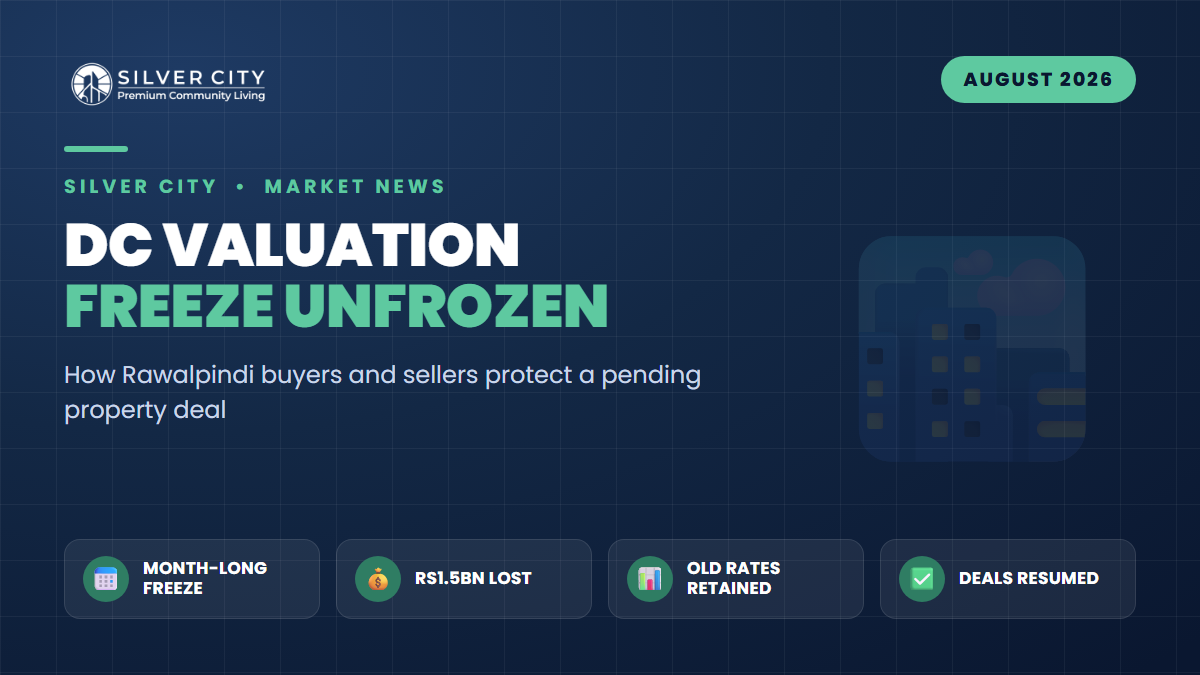
For roughly a month over the summer of 2026, Rawalpindi’s property market did something it almost never does: it stopped. When the new fiscal year opened on 1 July 2026, the district administration had not notified the revised District Collector (DC) valuation rates for FY2026-27 — the official floor used to calculate stamp duty, capital value tax and registration fees. Without that floor, sub-registrars could not compute duties, stamp vendors could not sell stamp papers, and the online e-registration system had nothing to price transactions against. Registrations and transfers were effectively frozen.
The freeze has since lifted, but the episode is a live case study in a risk every Rawalpindi buyer and seller now needs to understand. Here is exactly what happened, what it did to pending deals, and the practical steps that protect you the next time the stamp-duty base sits in limbo.
What actually happened
The revised valuation list had reportedly been finalised, but it was pulled back for review after a new Deputy Commissioner took charge — and the notification simply did not appear on time. Property dealers had warned for years that the schedule must be settled by 30 June to avoid exactly this gap. On a normal day, Rawalpindi records roughly 350–400 property registrations and 150–250 powers of attorney. During the freeze, that activity collapsed to near zero.
The stalemate ended when the new Deputy Commissioner chose to retain the previous year’s (FY2025-26) valuation rates for 2026-27 rather than impose a fresh hike. The online and biometric system came back fully live on 27 July 2026. Officials estimated the government lost around Rs1.5 billion in revenue over the shutdown — roughly Rs500 million a day in the early phase.
| Date (2026) | Event |
|---|---|
| 1 July | New fiscal year begins; FY2026-27 DC rates not notified |
| Early–mid July | Registrations, transfers and stamp-paper sales frozen district-wide |
| ~13 July | 12 days in with no notification; dealers warn of mounting losses |
| 26–27 July | DC retains FY2025-26 rates; online/biometric system resumes |
| After 14 August | Updated property tax bills expected to be dispatched |
Rates held — but your costs still went up
Do not confuse “rates retained” with “nothing changed.” The DC valuation base stayed flat, which is genuinely good news for the underlying value of a deal. But the taxes and fees layered on top of that base rose. Buyers now face higher advance tax and capital gains tax, and processing/mutation charges climbed. Filer status matters more than ever.
| Charge (FY2026-27) | Filer | Non-filer |
|---|---|---|
| Advance tax (236 series) | 1.25% | 10.5% |
| Capital gains / applicable tax | 2.75% | 11.5% |
| Property tax rates | Up 10–15% | |
| PLRA services fee | Rs3,800 | |
| Registration fee | Rs1,000 | |
| Express mutation | Rs11,200 | |
In practice, all-in additional registration costs are running around Rs30,000–Rs50,000 for residential and Rs50,000–Rs125,000 for commercial properties, depending on size and category. Being on the Active Taxpayer List (ATL) before you transact remains the single biggest lever on your bill.
What buyers should do
- Confirm the notified rate before you sign anything. Ask the sub-registrar or your lawyer to show you the current notified DC value for the exact block, phase and category. Never rely on a dealer’s verbal figure during a limbo period.
- Get on the ATL first. The filer/non-filer gap (1.25% vs 10.5% advance tax) dwarfs almost every other saving. File your return and confirm ATL status before payment day.
- Keep your token/advance conditional. Tie any advance to a clause that the deal completes on registration, and that a registration freeze extends the deadline without penalty.
- Budget for the tax increases, not last year’s numbers. Use the FY2026-27 percentages above, plus fixed PLRA and mutation fees, when you calculate your true landed cost.
What sellers should do
- Don’t accept a low offer justified by “uncertainty.” With FY2025-26 rates retained, the valuation base did not fall — resist buyers who use the freeze as a discount lever.
- Line up documents in advance. CNIC, prior title/registry, NOC/clearance from the society or authority, and tax challans ready means you register the moment the counter opens.
- Be ready for biometric verification. Both buyer and seller must appear for biometric verification; a missing party stalls an otherwise complete file.
- Clarify who bears rising costs in writing. Specify in the sale agreement which side pays advance tax, CGT, stamp duty and mutation, so a fee hike mid-process doesn’t blow up the deal.
How to protect a pending deal during a freeze
- Put the timeline in writing. A written sale agreement with a completion window — and a force-majeure/administrative-delay clause — protects the advance if registration is administratively suspended.
- Hold funds against registration, not the agreement. Structure payment so the final tranche releases on successful mutation/registration, not merely on signing.
- Track the notification, not the rumour. Watch for the official DC valuation notification and Board of Revenue confirmation before you pay duty. Stamp papers can only be issued once official rates are live.
- Verify RDA/authority approval of the scheme. A freeze at the registry is temporary; buying into an unapproved or disputed layout is a permanent problem. Confirm the society is approved and the file is legitimate before you commit.
- Keep every receipt. Retain challans, biometric slips and the agreement — they are your proof of the price and terms if a dispute arises later.
Frequently Asked Questions
Are Rawalpindi property registrations open again?
Yes. After roughly a month-long suspension, registrations and transfers resumed in late July 2026 once the Deputy Commissioner retained the FY2025-26 valuation rates for the new year. The online and biometric system is fully operational.
Did the DC valuation rates go up for 2026-27?
No. The district administration retained the previous year’s DC valuation rates rather than issuing a hike. However, advance tax, capital gains tax, property tax (up 10–15%) and several fixed fees did increase, so total transaction costs are higher even though the valuation base is unchanged.
Can I sign a sale agreement while rates are in limbo?
You can sign an agreement, but you cannot complete registration or pay stamp duty until official rates are notified. Protect yourself with a written agreement that ties completion to registration and extends the deadline if the registry is administratively frozen — and hold the final payment against mutation.
Does filer status really change my cost that much?
Substantially. Advance tax is about 1.25% for filers versus 10.5% for non-filers, and CGT-style tax is 2.75% versus 11.5%. Getting on the Active Taxpayer List before you transact is usually the largest single saving available to a buyer.
The takeaway
The 2026-27 freeze was a timing failure, not a market collapse — and it was resolved by holding rates steady, which is a reassuring signal for genuine buyers. The lesson is procedural: verify notified rates, secure filer status, and paper your deal so an administrative pause can’t cost you your advance. For investors who prefer to sidestep registry uncertainty altogether, buying into a properly approved, well-documented scheme matters more than any single valuation cycle. Silver City, an RDA-approved housing society in Rawalpindi, is one such option worth considering — clear approvals and transparent files make the registration process far smoother whenever the counters are open.