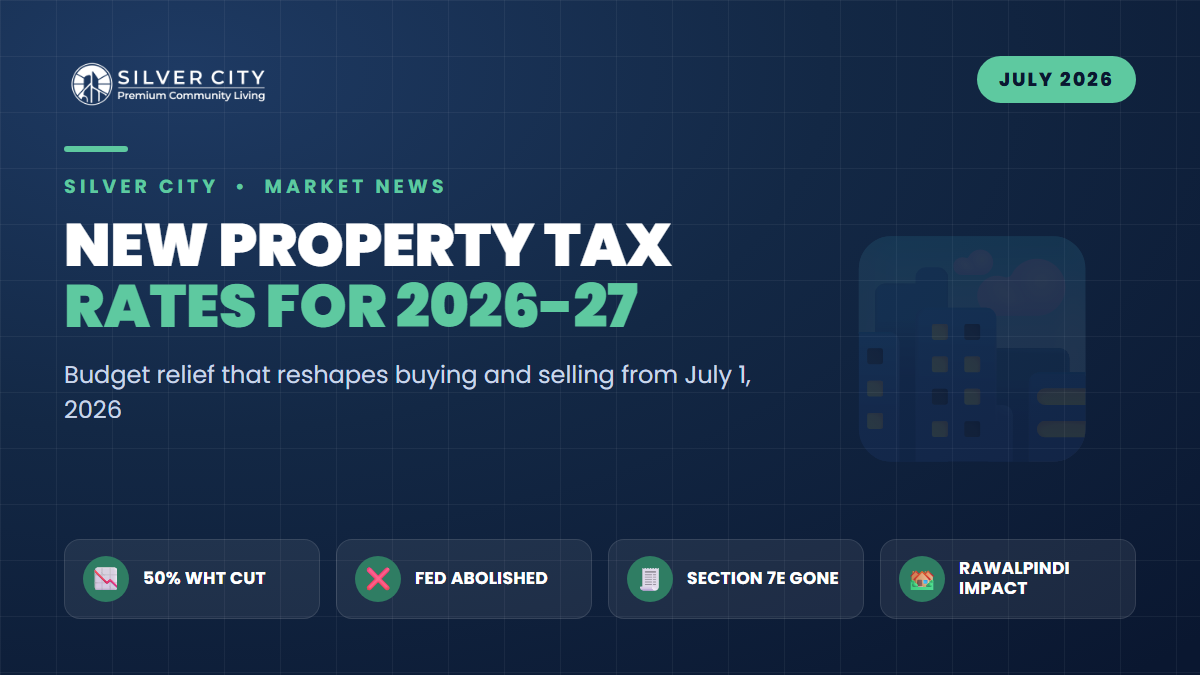
For the first time in years, Pakistan’s Budget 2026-27 delivers meaningful relief to property buyers and sellers rather than piling on new levies. Presented by Finance Minister Muhammad Aurangzeb in the National Assembly on 12 June 2026, and taking effect from 1 July 2026 (Tax Year 2027), the Finance Bill 2026 slashes advance tax rates for filers, abolishes the Federal Excise Duty (FED) on property, and scraps the controversial Section 7E “deemed income” tax. For investors in Rawalpindi and RDA-approved societies like Silver City, this is arguably the most transaction-friendly budget in half a decade.
What Actually Changed on 1 July 2026
The reforms target the three biggest friction points that had frozen much of Pakistan’s real-estate market since 2024: high transaction taxes, a double-charging FED, and a wealth-style tax on property you already owned. Here is the headline package:
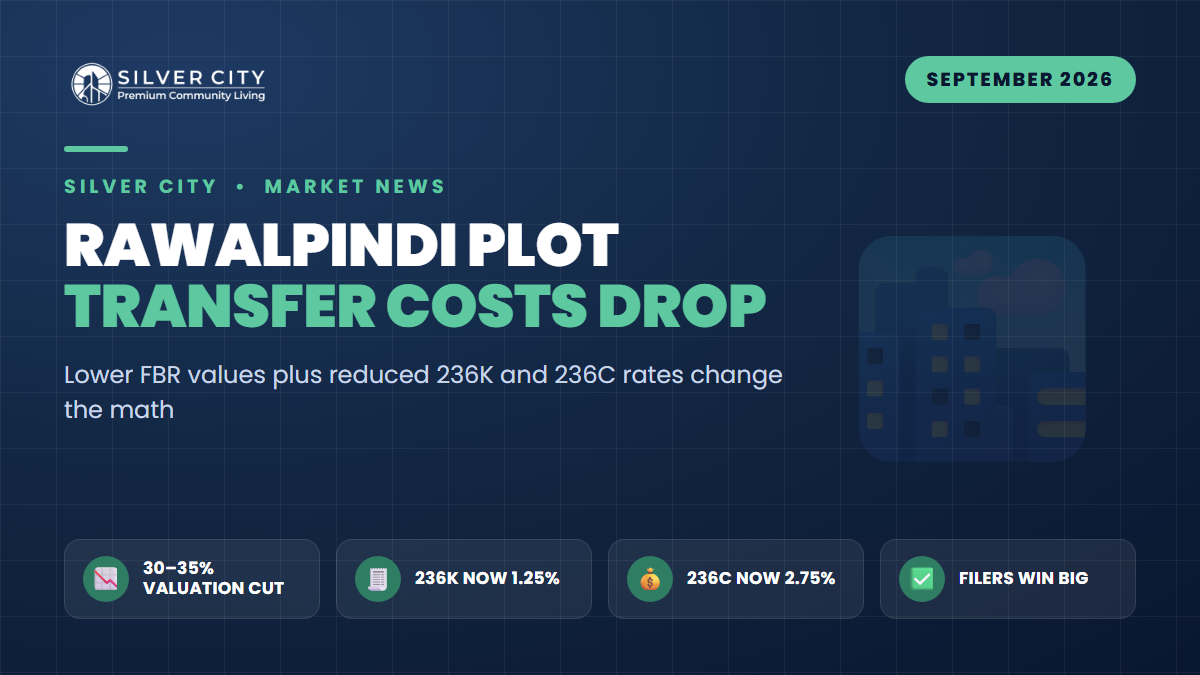
- 50% cut in withholding tax (WHT) for filers — advance tax on purchase drops from 2.5% to 1.25%, and on sale from 5.5% to 2.75%.
- Abolition of the FED on property — the Federal Excise Duty introduced in FY2024-25 (charged at 3% for filers, 5% for late filers, and up to 7% for non-filers on the first sale/allotment of plots and commercial property) has been removed entirely.
- Removal of Section 7E — the “deemed income” tax that treated 5% of the market value of certain properties as taxable rental income (taxed at 20%) has been withdrawn, ending a widely disputed compliance headache.
- Simplified advance-tax structure — a flatter 2.75% seller (Section 236C) and 1.25% buyer (Section 236K) rate for filers replaces the steeper slabbed rates.
Old vs New: The Numbers Side by Side
The table below compares the filer position before and after 1 July 2026. Non-filer and late-filer rates remain substantially higher, which is the government’s continued push toward documentation.
| Tax head | Who pays | Filer rate (pre-July 2026) | Filer rate (from July 2026) |
|---|---|---|---|
| Advance tax on purchase (236K) | Buyer | 2.5% (up to PKR 50M) | 1.25% |
| Advance tax on sale (236C) | Seller | 4.5%–5.5% | 2.75% |
| Federal Excise Duty (FED) | Buyer (first sale) | 3% filer / up to 7% | Abolished (0%) |
| Section 7E deemed income | Owner | 20% on 5% deemed value | Withdrawn |
Rates apply to active filers. Verify your exact slab and status against the Finance Act 2026 and current FBR notifications before any transaction, as figures vary by property value and filer category.
A Worked Example for a Rawalpindi Investor
Consider a filer buying a PKR 20 million residential plot in an RDA-approved society and later selling it as a filer. Under the previous regime, the buyer paid roughly PKR 500,000 in 236K WHT (2.5%) plus a 3% FED of PKR 600,000 — about PKR 1.1 million just in federal charges at entry. From July 2026, the same buyer pays only 1.25% WHT (PKR 250,000) and no FED — a saving of roughly PKR 850,000 on that single purchase.
On the sale side, the seller’s 236C advance tax falls from about 5.5% (PKR 1.1 million on a PKR 20M sale) to 2.75% (PKR 550,000). Combined, the round-trip federal tax burden on a mid-sized plot roughly halves — a decisive difference for flippers and medium-term holders whose margins had been squeezed by transaction costs.
Why This Matters for Silver City and Rawalpindi
Rawalpindi’s RDA-approved corridor — along the GT Road, Adiala Road, and the Chakri interchange belt near the Rawalpindi Ring Road — has been one of the more resilient markets in the twin cities. The 2024-25 tax load, however, priced out many genuine buyers and pushed transactions into limbo. The 2026-27 relief directly addresses that:
- Lower entry cost revives demand from end-users and first-time investors who had been sitting on the sidelines.
- Abolishing FED removes a double-charge that hit new file and plot allotments hardest — exactly the primary-market product that RDA societies sell.
- Scrapping Section 7E ends a recurring annual liability on undeveloped or non-income-producing plots, making buy-and-hold strategies cleaner.
- Filer premium widens — the reforms reward filers heavily, so registering on the Active Taxpayers List (ATL) before you transact is now more valuable than ever.
Action Points Before You Transact
- Get on the ATL. Every headline rate above assumes filer status. A non-filer forfeits the entire 50% saving and may face restrictions on high-value purchases.
- Confirm RDA approval. Tax relief only protects you if the society itself is legitimate. Always verify layout and NOC status directly with the Rawalpindi Development Authority.
- Time your deal. Transactions registered on or after 1 July 2026 fall under the new rates; deals executed earlier used the old regime.
- Keep documentation clean. The government’s stated goal is formalisation — retain payment trails, CNIC records, and registry documents to defend your filer benefits.
Frequently Asked Questions
Do the new lower rates apply to non-filers too?
No. The 50% reduction and the flat 1.25% buyer / 2.75% seller rates apply to active filers on the ATL. Non-filers and late filers continue to pay significantly higher advance tax, which is precisely the incentive the government is using to expand the tax net. Becoming a filer before you buy or sell is the single most effective way to cut your bill.
Is the Federal Excise Duty on property gone permanently?
The Finance Bill 2026 abolishes the FED on property allotment and first sale/transfer that was introduced in FY2024-25. As with any tax measure, it remains subject to future budgets, but for Tax Year 2027 (from 1 July 2026) no FED is charged on property transactions. Always confirm the position at the time of your deal via a current FBR notification.
What was Section 7E and why does its removal help me?
Section 7E taxed a “deemed” income — treating 5% of the fair market value of certain properties as if it were rental income and taxing it, even when the property generated no actual rent. It was widely criticised and created disputes and compliance costs. Its withdrawal means owners of vacant or undeveloped plots no longer face this annual notional liability.
How much can a typical Rawalpindi buyer actually save?
On a PKR 20 million filer purchase, dropping WHT from 2.5% to 1.25% and removing a 3% FED saves roughly PKR 850,000 at entry alone. Combined with the halved seller advance tax, the total federal cost of a buy-and-sell cycle can fall by close to 50% versus the previous year.
The Bottom Line
Budget 2026-27 rebalances Pakistan’s property market toward genuine, documented investors. Lower transaction taxes, no FED, and the end of Section 7E together reduce the cost and complexity of owning real estate — provided you are a filer. For those looking at Rawalpindi’s growing RDA-approved corridor, Silver City (silvercity.pk), an RDA-approved housing society, is one option worth evaluating in this friendlier tax environment. As always, verify current rates against the Finance Act 2026 and confirm any society’s approval status with the RDA before committing your capital.